
Publishing Clinical Trial Results: A Sponsor’s Guide to Manuscript Writing and Journal Submission
A sponsor completes a Phase III trial with a positive primary endpoint. The database is locked, the clinical study report is filed, and the regulatory submission is in. Manuscript writing comes next. Six months later, two journals have rejected the draft. It now sits in a third journal’s review queue, and the lead author has been unavailable for a month. The data is good. The trial worked. But the publication process is drifting. The clinical evidence that regulators and prescribers should reference has not yet reached the public domain.
Manuscript writing for clinical trials is not a formality that follows the real work. It is a discipline with its own requirements: structural frameworks, authorship standards, journal selection strategy, and a submission process that can take twelve to eighteen months from first draft to accepted paper. Sponsors who plan for it get their results published. Sponsors who treat it as an afterthought lose time, sometimes lose the publication entirely, and occasionally find that a competitor has published a comparable study first.
Key takeaways
- Manuscript writing for clinical trials should be planned before the trial ends, not after the clinical study report is filed. Publication timelines of twelve to eighteen months are typical for peer-reviewed journals.
- CONSORT reporting guidelines require a flow diagram and structured reporting for randomised controlled trials. ICMJE member journals require clinical trial registration before the first patient is enrolled as a condition of considering the manuscript for publication.
- Journal selection determines the review process, the peer reviewer pool, and the likely revision burden. Choosing a journal whose scope does not fit the study type is the most common reason for desk rejection.
- ICMJE authorship criteria require four conditions to be met: substantial intellectual contribution, drafting or critically revising the manuscript, approval of the final version, and accountability for the work. Authors should confirm they meet all criteria before drafting begins.
- The peer review process from submission to first decision takes six to sixteen weeks at most journals. Major revision cycles add another eight to twelve weeks each.
- ICMJE member journals require data sharing statements in manuscripts reporting clinical trial results. This requirement applies to all trials that began enrolling participants from January 2019 onward.
Why publication planning should start before the trial ends
The decision about where to publish, who the authors will be, and what the primary publication will say should be made while the trial is still running. Waiting until after the database lock to begin these discussions wastes time and often creates friction that delays the manuscript by months.
Journal registration is one reason to start early. ICMJE member journals, which include the New England Journal of Medicine, JAMA, The Lancet, BMJ, and hundreds of other peer-reviewed publications, require that clinical trials be registered in a WHO-approved public registry at or before first patient enrolment. They treat this registration as a condition of considering the manuscript. If a trial missed that registration window, ICMJE-member journals will not review it. Most APAC sponsors know this requirement, but the specific registry used matters. ClinicalTrials.gov, the ISRCTN registry, the EU Clinical Trials Register, and several national APAC registries, including CTRI (India) and ANZCTR (Australia and New Zealand), all carry WHO approval. When the trial uses a WHO-approved registry, the registration number should appear at the end of the abstract in the manuscript.
An author agreement is a second reason to plan early. Once the trial data exists, authorship discussions become politically charged. Agreeing on the author list, the order, and the contributorship statements before the results are known is far easier and reduces the disputes that delay manuscripts at the revision stage.
Manuscript writing structure: what CONSORT and ICMJE require
For randomised controlled trials, CONSORT (Consolidated Standards of Reporting Trials) provides the reporting framework. CONSORT requires a 25-item checklist covering every element of study reporting from title through funding disclosure. It also requires a flow diagram showing how participants moved through the trial: screened, randomised, allocated, followed up, and analysed. Most journals that publish RCT results require both the CONSORT checklist and the flow diagram alongside the manuscript.
The standard manuscript structure for a clinical trial publication follows the IMRAD format: Introduction, Methods, Results, and Discussion. Each section has specific content requirements under both CONSORT and ICMJE recommendations.
Introduction
The introduction states the scientific and clinical rationale for the trial, describes the hypothesis, and ends with a clear statement of the study objective. It should be concise: two to four paragraphs is the norm. The introduction does not summarise the results.
Methods
The methods section is the most important section for peer reviewers. It must describe the study design and setting, participant eligibility criteria, and the interventions in enough detail to allow replication. It must also cover the primary and secondary outcomes with their definitions and measurement methods, the sample size calculation with assumptions, and randomisation and blinding procedures. The statistical analysis plan belongs here, too. For studies conducted in APAC, the methods section should name the regulatory authorities that approved the trial, the ethics committees consulted, and the GCP standard followed. Trials conducted after July 2025 in EMA markets or September 2025 in FDA markets should reference ICH E6(R3).
Results
The results section presents the data in the sequence that the methods establish. It starts with participant flow (the CONSORT flow diagram appears here or as a referenced figure), moves through baseline characteristics, then primary outcome results, and then secondary outcomes. Every table and figure must appear in the text as a reference. Statistical results must include point estimates, confidence intervals, and p-values consistently throughout. The results section does not interpret the data: that is the discussion’s job.
Discussion
The discussion places the results in context. It starts with a statement of the principal finding, moves to comparison with existing evidence, addresses the study’s limitations honestly, and ends with a statement of clinical or scientific implications. Peer reviewers read the limitations section carefully, so authors should not minimise it. A manuscript that acknowledges limitations clearly is easier to publish than one that pretends to have none.
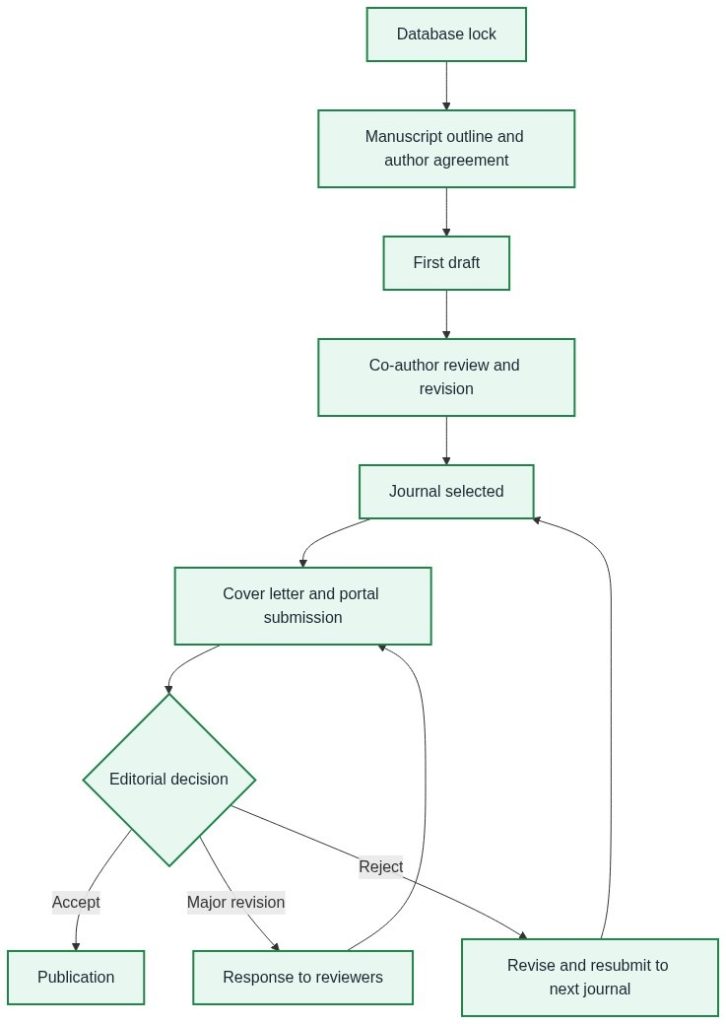
Flowchart manuscript publication pathway from database lock to accepted paper, TD direction
Journal selection: matching your study to the right publication
Desk rejection, where the editor declines the manuscript without sending it to peer review, is the most common outcome of a mismatched journal submission. It wastes two to four weeks and requires resubmission to a different journal. The most common causes of desk rejection are: the study type or therapeutic area does not fit the journal’s stated scope; the manuscript does not meet the journal’s word count or format requirements; or the journal does not publish industry-sponsored trials (some journals explicitly restrict these).
Journal selection should rest on four factors. The first is scope: the journal must publish studies in the relevant therapeutic area and study type. The second is the target audience. When the primary audience is regulators and drug developers, a regulatory science or clinical pharmacology journal fits better than a high-impact general medical journal. When the audience is clinical practitioners, a specialty clinical journal in the relevant therapeutic area is the right home. The third factor is impact factor and indexing: journals indexed in PubMed and MEDLINE provide the widest visibility for regulatory and scientific citations. The fourth is open access requirements. Some sponsors, particularly those receiving public research funding, must publish open access.
For consumer health and nutraceutical studies, the target journal determines the study design requirements, not the other way around. Oral health journals, food science journals, and nutrition journals each hold different expectations for study size, endpoints, and statistical reporting. Credevo’s publication support team advises on journal selection before drafting begins, so the team writes the manuscript to the specific journal’s requirements from the start rather than reformatting it after a rejection.
Authorship and contributorship: the ICMJE criteria
ICMJE authorship criteria require all four of the following conditions for an individual to qualify as an author: substantial contribution to conception or design, or to data acquisition, analysis, or interpretation; drafting the article or critically revising it for important intellectual content; final approval of the version to be published; and agreement to be accountable for all aspects of the work. ICMJE-member journals treat all four criteria as non-negotiable. A contributor who meets only the first and third criteria does not qualify as an author under the ICMJE definition and should appear in the acknowledgements instead.
Contributorship statements are required by most journals and should be drafted before writing begins. Each author’s specific contribution appears in the statement, for example, “PJ conceptualised the study and supervised the analysis; RS drafted the manuscript and prepared the figures; KN managed site operations and contributed to the methods section.” This process also confirms early that every listed author genuinely meets all four ICMJE criteria.
Ghost authorship (where the actual writer does not appear in the author list) and gift authorship (where individuals who do not meet the criteria appear as authors) both constitute publication misconduct and can result in retraction. For industry-sponsored trials, ICMJE journals expect transparency about sponsor involvement in study design, data collection, analysis, and the decision to publish.
The submission process: cover letter, portal handling, and what editors look for
The cover letter is the editor’s first impression of the manuscript. It should state the study type and primary finding in two sentences, confirm that the manuscript has not gone elsewhere and is not under consideration at another journal, disclose any conflicts of interest, and confirm that all authors meet ICMJE criteria. The cover letter is not the place to oversell the study. Editors read hundreds of cover letters and respond better to factual clarity than to claims about clinical significance.
Most journals now use online submission portals. The submission process typically requires the manuscript as a Word file or PDF, a separate title page with author details (submitted blind in double-blind review journals), the CONSORT checklist (for RCTs), all figures and tables as separate files, supplementary materials, and the data sharing statement. The trial registration number must appear at the end of the abstract.
After submission, the editor performs an initial assessment, typically within one to two weeks, to determine whether the manuscript will go to peer review or receive a desk rejection. If it goes to peer review, journals typically take six to sixteen weeks to reach a first decision, depending on the journal and the availability of suitable reviewers.
Peer review: responding to reviewers and handling revisions
Most manuscripts return with revision requests before acceptance. Major revision requests are common even for well-conducted studies. Reviewers may ask for additional sensitivity analyses, expanded limitations sections, clarification of methods, or changes to the presentation of results. A revision request is not a rejection: it is an invitation to address specific concerns and resubmit.
The revision response document is as important as the revised manuscript. It should address every reviewer comment, numbered, in order. For each comment, the response should explain what change the authors made and where in the revised manuscript it appears, or provide a detailed explanation of why no change was appropriate. A dismissive or incomplete response to reviewer comments is the most common reason for rejection after revision.
For sponsors using Credevo’s publication support service, the medical writing team manages the full review correspondence: drafting responses, tracking revision cycles, managing resubmission portal deadlines, and coordinating with co-authors on revision approvals. The ICMJE recommendations for manuscript preparation and the CONSORT reporting guidelines are the primary references our team applies to every manuscript.
For sponsors who want to understand how the CSR produced at the end of a trial connects to the publication process, Credevo’s article on protocol writing in clinical trials covers how document planning earlier in the study affects the quality of downstream scientific outputs. For a broader view of how publication support fits into clinical trial project management, project management in clinical trials is the reference guide.
Timeline from database lock to accepted manuscript
Sponsors consistently underestimate how long publication takes. A realistic timeline from database lock to an accepted manuscript in a peer-reviewed journal is twelve to eighteen months. The phases break down as follows: manuscript drafting takes four to eight weeks for a well-prepared team with access to the final data; co-author review and revision adds two to four weeks; journal selection and cover letter preparation takes one to two weeks; the first editorial decision takes two to six weeks; peer review takes six to sixteen weeks; responding to reviewers and resubmission adds four to eight weeks; and a further review round, which is common, adds another four to eight weeks.
Sponsors who want results in print within twelve months of database lock should begin the manuscript outline before database lock and confirm the author list and journal before the data is finalised. Using a dedicated publication support team also helps, rather than leaving drafting to investigators who are simultaneously running other trials. Credevo’s publication support service covers the full process: manuscript writing to CONSORT and ICMJE standards, journal selection, submission portal management, and revision response drafting across all relevant peer-reviewed journals in the study’s therapeutic area.
[VISUAL: bar chart or timeline diagram, typical publication timeline phases from database lock to accepted manuscript, with estimated weeks per phase]
[VISUAL: checklist table, ICMJE authorship criteria with four conditions and examples of qualifying contributions]
Conclusion
Publishing clinical trial results is not a single task. It is a coordinated process that runs from trial registration through peer-reviewed publication, with authorship, journal selection, CONSORT compliance, data sharing, and revision management as distinct steps. Sponsors who plan for publication as part of the trial programme, not as an afterthought, get their results into print faster, in the right journals, and with fewer revision cycles. The data from a well-run trial deserves a publication that reflects the same standard.
Do You Need Support Writing and Submitting Your Clinical Trial Manuscript?
If you have completed a clinical trial and need end-to-end support with manuscript writing, journal selection, submission management, or revision responses, Credevo’s publication support team works across all therapeutic areas and study types. Please fill out the form below to connect with our team.
Frequently asked questions
Does every clinical trial need to be published?
No universal legal requirement compels sponsors to publish every clinical trial, but a strong ethical and regulatory norm favours publication of results, both positive and negative. WHO’s Joint Statement on Public Disclosure of Results from Clinical Trials calls for all trials to report results within twelve months of completion. ICMJE and most ethics committees expect sponsors to intend publication as a condition of ethical approval. For trials on ClinicalTrials.gov, the FDA Amendments Act of 2007 requires results reporting within twelve months of trial completion for applicable clinical trials. Failure to publish negative results contributes to publication bias, a recognised problem in the scientific literature. Credevo recommends planning publication for every interventional trial from the point of protocol finalisation.
What is a data sharing statement, and is it mandatory?
A data sharing statement describes whether the individual patient-level data from the trial will be available to other researchers, and if so, how and under what conditions. ICMJE member journals have required data sharing statements in manuscripts reporting clinical trial results since 2018. For trials that began enrolling participants on or after 1 January 2019, ICMJE member journals require that the data sharing plan appear in the trial’s registration record. The statement does not require that data be made publicly available. It can state that data is available on request, available via a qualified access repository, or not available, with the reasons given. The statement must appear in the manuscript regardless of whether the data will actually be shared.
What is the difference between a primary publication and a secondary publication?
The primary publication reports the trial’s primary endpoint and principal results. Secondary publications report secondary endpoints, subgroup analyses, safety data in more detail, or specific biomarker or pharmacokinetic findings. Most journals require that secondary publications explicitly reference the primary publication and confirm that the data come from the same trial. Sponsors who plan a series of publications should agree on the publication plan with all co-authors before submitting the first manuscript. This avoids disputes about which findings appear in which paper and in what order.
How do you choose between open-access and subscription journals?
Open access publishing makes the article freely available to anyone immediately upon publication, without a subscription. This maximises the reach of the results and is increasingly required by public funders such as NIH, Wellcome Trust, and many EU funding bodies. The trade-off is an article processing charge (APC) that ranges from approximately USD 1,500 to USD 6,000 per article at high-impact journals. Subscription journals do not charge APCs but restrict access to subscribers. Most major journals now offer a hybrid model where the author can choose open access for an additional fee within an otherwise subscription journal. Credevo’s publication support team advises on the open access implications of each journal under consideration, including funder mandates that may require a specific route.
What happens if a manuscript is rejected after peer review?
A post-review rejection means the peer reviewers and editor assessed the manuscript and found it unsuitable for the journal, despite a full review. The journal still provides reviewer comments, and those comments are valuable for revision. The authors should revise the manuscript in response to the substantive reviewer concerns before resubmitting to a different journal, even when reviewers framed those concerns as reasons for rejection rather than revision requests. Submitting an unchanged manuscript to the next journal after a detailed peer review rejection is a common mistake. The next journal may use some of the same reviewers, or the same fundamental problems will resurface. Most sponsors benefit from a short revision cycle with the publication support team before moving to the next journal on the target list.