
Singapore vs. Malaysia for Phase II Clinical Trials: Regulatory Speed, Site Quality, and Cost
Singapore and Malaysia are the two most-cited APAC markets for sponsors planning Phase II clinical trials outside Japan, India, and Australia. Both have strong regulatory frameworks, experienced investigator pools, and GCP-compliant site infrastructure. Because they are close enough in quality to require a deliberate choice, and different enough in cost and timelines for that choice to matter, a clear framework is more useful than a vague “it depends.”
In practice, a Phase II sponsor needs to resolve five dimensions: regulatory timeline, investigator quality, patient access, IMP logistics, and cost. This article provides a clear recommendation framework rather than a diplomatic non-answer.
Key takeaways
- Singapore’s Health Sciences Authority (HSA) typically approves Phase II clinical trial applications in 3 to 4 months. Malaysia’s National Pharmaceutical Regulatory Agency (NPRA) typically takes 6 to 9 months.
- Malaysia’s patient pool is approximately five times larger than Singapore’s (33 million versus 6 million), with higher disease prevalence in oncology, metabolic, and infectious disease indications.
- Singapore offers a higher average compliance floor across its investigator network, making it the stronger anchor for first-in-APAC entries or studies where inspection readiness is a primary concern.
- IMP logistics are significantly simpler in Singapore. Cold-chain infrastructure at Changi Airport is world-class, whereas Malaysia’s NPRA import permit process adds 4 to 8 weeks per shipment.
- Malaysia’s all-in site costs typically run 25 to 35% lower than Singapore equivalents, a meaningful difference at Phase II volumes.
- The strongest Phase II designs in this region often use both: Singapore as the regulatory anchor that activates first, Malaysia as the volume engine once NPRA approval follows.
How to read this comparison
This comparison is a Phase II sponsor’s working framework, not an academic overview. Every comparison involves trade-offs. In particular, the right answer depends on your protocol, therapeutic area, and operational risk tolerance. Where a dimension is a clear win for one country, that is stated directly. Where it is genuinely context-dependent, the conditions are given.
| Dimension | Singapore | Malaysia | Winner |
|---|---|---|---|
| Regulatory timeline | 3 to 4 months (HSA CTA) | 6 to 9 months (NPRA + MREC in series) | Singapore by 3 to 5 months |
| Investigator quality | Fewer sites, higher average compliance floor | More sites, wider quality range; top tier comparable to Singapore | Singapore for consistency; Malaysia for depth in high-prevalence TAs |
| Patient access | 6M population; limited for high-enrolment Phase II | 33M population; higher disease prevalence in oncology, metabolic, and infectious disease | Malaysia by a significant margin for volume-dependent studies |
| IMP logistics | Changi Airport world-class cold-chain; straightforward import authorisation | KLIA adequate; NPRA import permit required, 4 to 8 weeks per shipment | Singapore clearly simpler |
| Cost | Higher site, CRA, and operational costs | 25 to 35% lower all-in site costs; lower CRA costs | Malaysia for cost efficiency |
Regulatory timelines: HSA vs. NPRA
Singapore: Health Sciences Authority (HSA)
The HSA Clinical Trials Branch runs a Clinical Trial Authorisation (CTA) process that is consistently among the fastest in APAC. For a standard Phase II protocol, the typical timeline from complete submission to CTA approval is 3 to 4 months. HSA operates a risk-based review system. Phase I and first-in-human studies receive additional scrutiny, whereas Phase II studies in well-characterised indications move through more quickly. HSA’s electronic submission system is mature, and the agency is responsive to pre-submission queries. The current clinical trial guidelines are published at hsa.gov.sg/clinical-trials, which is a useful reference before preparing a submission.
Malaysia: National Pharmaceutical Regulatory Agency (NPRA)
NPRA approval for Phase II clinical trials typically takes 6 to 9 months from complete submission. The process involves NPRA technical review followed by approval from the Medical Research and Ethics Committee (MREC), which review in series rather than in parallel. MREC review adds 6 to 12 weeks on top of NPRA technical review in most cases.
Malaysia has been making regulatory improvements. As a result, the timeline for straightforward protocols in established therapeutic areas has shortened over the last two years. Complex protocols, biologics, and gene therapy trials still require extended timelines, however. Sponsors who have worked with both agencies describe HSA as more predictable and faster. NPRA approval, however, carries equal regional credibility once obtained.
Verdict: For Phase II clinical trials, Singapore leads by 3 to 5 months on regulatory timelines. If regulatory speed is a primary constraint (particularly when first-patient-in timing affects IND milestones or competitive market entry), Singapore is therefore the clear first choice.
Investigator quality and site landscape
Singapore’s clinical research infrastructure is anchored by its public hospital system. Key sites include National University Hospital (NUH), Singapore General Hospital (SGH), Tan Tock Seng Hospital (TTSH), and the National Cancer Centre Singapore (NCCS). These are GCP-compliant, ICH-aligned institutions whose investigators participate regularly in multinational Phase II and III trials.
The investigator pool is smaller than Malaysia’s, but the average quality floor is higher. GCP compliance consistency, documentation standards, and inspection readiness are therefore stronger across Singapore’s major hospitals than across the Malaysian site network as a whole. For these reasons, Singapore is the stronger anchor for first-in-APAC entries and high-complexity protocols. It is also the right choice when FDA or EMA inspection of a trial site is a realistic possibility.
Malaysia’s investigator landscape is larger and more uneven. Top-tier sites are comparable in quality to Singapore’s best hospitals. These include Hospital Kuala Lumpur (HKL), University Malaya Medical Centre (UMMC), Hospital Ampang for haematology and oncology, and Universiti Kebangsaan Malaysia Medical Centre (UKMMC). Below that tier, however, quality and GCP compliance consistency drop more sharply than in Singapore.
The practical implication is that site selection in Malaysia requires more rigorous feasibility work than Singapore. The difference between the top five sites and the next ten is meaningful in Malaysia. In Singapore, by contrast, the public hospital network is more uniformly maintained. Malaysia is therefore the stronger anchor for studies that need patient volume and can accept more intensive site management overhead.
Verdict: For Phase II clinical trials, Singapore leads on quality floor and inspection confidence. Malaysia leads on investigator volume and depth in high-prevalence indications.
Patient access and recruitment
This is where the Phase II clinical trials comparison is most decisive. Singapore has a population of approximately 6 million. That population is affluent, healthy, and ethnically diverse, which is useful for PK studies and certain early-phase work. However, it is too small to carry most Phase II recruitment targets alone. Studies requiring 80 to 150 patients in a Phase II randomised trial will find Singapore insufficient as a single-country solution without very long enrolment timelines.
Malaysia, by contrast, has a population of approximately 33 million. Disease prevalence is high across chronic conditions: type 2 diabetes, cardiovascular disease, hepatocellular carcinoma, colorectal cancer, and infectious disease including hepatitis B and dengue. Patient availability in these indications is meaningfully higher per site than in Singapore. Competing-trial density at Malaysian sites also remains lower than at equivalent Singapore sites for most indications.
| Indicator | Singapore | Malaysia |
|---|---|---|
| Total population | ~6 million | ~33 million |
| Oncology prevalence | Moderate; colorectal, breast, and lung most common | High; hepatocellular carcinoma, colorectal, nasopharyngeal, breast |
| Metabolic disease | Moderate diabetes and cardiovascular disease prevalence | High; one of the highest type 2 diabetes rates in Southeast Asia |
| Infectious disease | Lower burden; dengue present | Hepatitis B, dengue, and HIV present at higher rates |
| Competing-trial density | Higher at leading sites | Lower at most sites outside Kuala Lumpur |
Verdict: For Phase II clinical trials where enrolment volume is the primary constraint, Malaysia leads by a significant margin. Singapore is sufficient for studies with modest recruitment requirements or where tight quality control justifies slower enrolment.
IMP logistics and import requirements
Changi Airport has world-class cold-chain handling infrastructure, with multiple qualified pharmaceutical logistics providers operating import clearance on a next-day basis for most shipment types. HSA’s Therapeutic Products Import Licence system is well-established, and import authorisations for investigational products are processed predictably. For biologics requiring 2 to 8 degrees Celsius or ultra-cold storage, Singapore’s in-country logistics chain is one of the most reliable in APAC. For these reasons, the logistics risk for IMP in Singapore is low.
IMP import into Malaysia, however, requires NPRA import approval, which can take 4 to 8 weeks per shipment authorisation. For ongoing supply logistics, this requires advance planning of 6 to 8 weeks before each anticipated shipment. KLIA has adequate pharmaceutical logistics infrastructure, though it is less developed than Changi. For this reason, building contingency into IMP supply schedules is recommended for Malaysia.
For sponsors managing IMP supply across multiple APAC countries, Singapore often serves as the regional IMP hub with in-country distribution to Malaysia and other markets. This approach therefore simplifies customs management across the portfolio.
Verdict: Singapore is clearly simpler for IMP logistics. Malaysia requires more planning but is manageable with an experienced local logistics partner.
Cost comparison
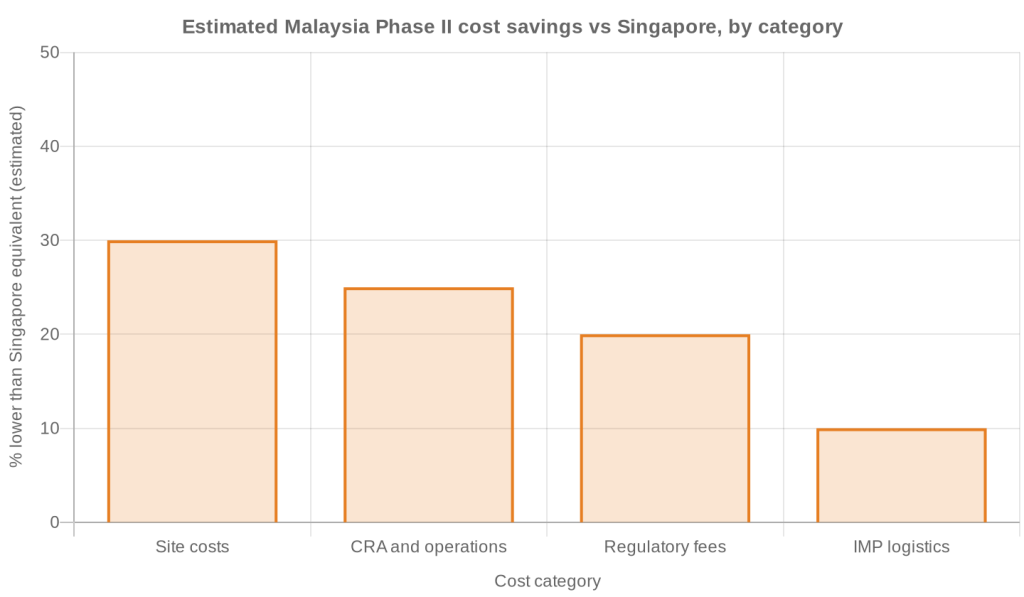
This is one of the clearest differentials between the two markets. Site costs, including investigator fees and site overhead, typically run 25 to 35% lower in Malaysia than in Singapore. For a Phase II study with 60 to 100 patients across four to six sites, the cost difference can reach USD 200,000 to 400,000 over the study lifecycle. This figure varies by protocol complexity and indication.
In addition, CRA and operational costs are lower in Malaysia. Singapore-based clinical operations staff, in addition, command higher rates than Malaysian equivalents. IMP logistics costs in Singapore are higher per shipment, which partially offsets the site cost advantage, particularly for biologics with complex cold-chain requirements. However, the net Malaysia saving across all cost categories is still substantial.
All-in, therefore, a Phase II study running equivalent protocols in the two countries will typically cost 20 to 30% more in Singapore. The chart below shows this broken down by cost category, based on Credevo’s operational data from active Phase II programmes in both markets. Each bar shows how much lower the Malaysia cost is as a percentage of the Singapore equivalent.
Figure 1: Estimated Malaysia Phase II cost savings vs Singapore, by cost category. Figures are approximate and will vary by protocol, indication, and number of sites. Source: Credevo operational data.
Verdict: Malaysia for cost efficiency. The difference is meaningful at Phase II budgets and decisive for sponsors managing tight development economics.
Choosing the right market for your Phase II clinical trials
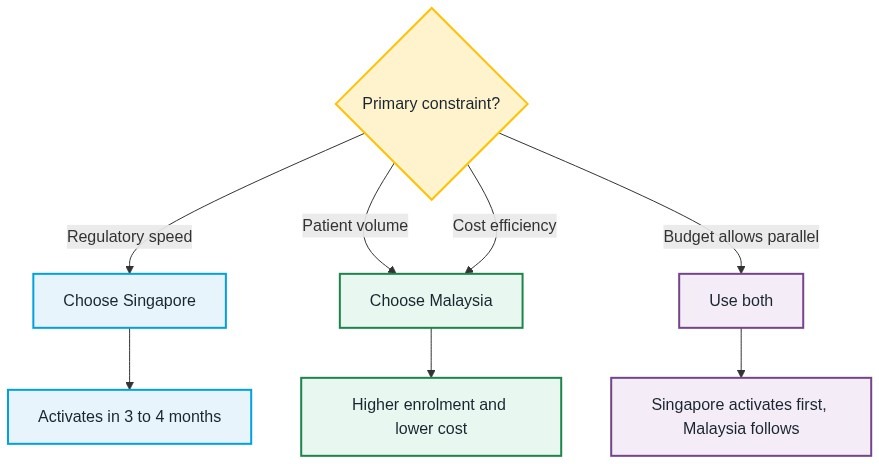
The decision framework for Phase II clinical trials is straightforward. Once the primary constraint is clear, the right choice follows logically.
Figure 2: Phase II country selection decision framework for Singapore and Malaysia.
Choose Singapore when
Regulatory speed is a primary constraint and first-patient-in timing matters for IND or milestone purposes. Singapore is therefore also the right anchor when the protocol is complex, early-phase in APAC, or involves a first-in-class mechanism where inspection confidence is important. For studies with modest recruitment targets (under 40 to 50 patients) or complex IMP logistics, Singapore’s supply chain is the lower-risk choice.
Choose Malaysia when
Patient access is the primary constraint and enrolment volume matters more than regulatory speed. Malaysia is also strong when the protocol is in an indication where Malaysian disease prevalence creates a clear recruitment advantage. When budget pressure is real and a 25 to 35% site cost reduction affects development viability, Malaysia is therefore the more efficient choice.
Use both when
Budget allows and both regulatory processes can run in parallel. Singapore activates first (3 to 4 months) while Malaysia is still in review (6 to 9 months). You therefore get early data while building towards full target enrolment. As a result, the dual-country approach is the strongest design for most Phase II programmes in Southeast Asia. Singapore provides the quality anchor and early data; Malaysia provides the enrolment engine. Credevo operates across both markets. As a result, the dual regulatory strategy, site selection, and monitoring can all be managed under a single operational structure. For broader context on choosing between APAC markets, see Choosing Asia-Pacific for your clinical trials.
Conclusion
Singapore and Malaysia are not interchangeable. Treating them as equally valid alternatives without a deliberate choice is, in fact, one of the most common mistakes in APAC Phase II planning. Singapore gives you speed, quality consistency, and logistics simplicity. Malaysia gives you patient volume, cost efficiency, and investigator depth in high-prevalence indications. The right answer depends on whether your Phase II is primarily constrained by regulatory timelines, patient access, or budget. For most programmes, however, the strongest outcome comes from using both rather than picking one. The two markets are complementary rather than interchangeable.
Are You Planning a Phase II in Singapore, Malaysia, or Both?
If you want a current feasibility view, including realistic regulatory timelines, site options, and a side-by-side cost estimate for your specific protocol, Credevo can put that together before you finalise your country plan. Please fill out the form below to connect with our team.
Frequently asked questions
Can I run a Phase II in Malaysia without also running in Singapore?
Yes. Malaysia as a standalone Phase II country is viable for sponsors where enrolment volume and cost are the primary concerns. The 6 to 9 month regulatory timeline, however, must be acceptable to the sponsor’s programme schedule. The main considerations are site selection rigour, since the quality gap between top-tier and mid-tier Malaysian sites is wider than in Singapore, and IMP logistics planning. In practice, many sponsors run Malaysia-only Phase II studies successfully. It requires more careful site management than Singapore, but it is not inherently higher risk.
Does Singapore accept overseas clinical trial data for marketing authorisation submissions?
Yes. HSA accepts data from multinational trials conducted to ICH GCP standards. As a result, international clinical data is a standard component of most HSA marketing authorisation submissions. Sponsors do not therefore need to run a Singapore-specific trial arm to eventually seek HSA registration, though Singapore site data does strengthen local regulatory dossiers.
How does NPRA handle sites outside Kuala Lumpur?
In Malaysia, NPRA approval covers the trial nationally, not by individual site location. Sites outside Kuala Lumpur, in Penang, Johor, or Kota Kinabalu for example, can be included under the same NPRA approval. Each site requires individual ethics committee approval from its institutional ethics committee. Adding regional Malaysian sites extends startup timelines at the site level, but it does not require separate NPRA approvals.
What is the typical investigator fee structure in Singapore vs. Malaysia?
Both markets use per-procedure or per-patient visit fee structures. In addition, annual retainer fees apply at some sites. Singapore investigator fees are typically 30 to 50% higher than Malaysian equivalents for equivalent procedures in the same therapeutic area. Both markets also allow sponsor-negotiated fee agreements with principal investigators, within guidelines set by the respective national medical associations.
Is English sufficient for trial documentation in both countries?
Yes for both. English is the working language for clinical trial submissions, informed consent forms, and source documents at major research sites in Singapore and Malaysia. Malaysia, however, additionally requires a Bahasa Malaysia translation of the patient information sheet and informed consent form. Singapore requires only English-language consent documentation at most sites, though bilingual versions may be requested by individual sites serving specific patient populations.
Glossary
- CTA (Clinical Trial Authorisation): The regulatory approval issued by a national authority permitting a clinical trial to begin.
- GCP (Good Clinical Practice): The international quality standard for clinical trial design, conduct, and reporting. Set by the ICH.
- HSA (Health Sciences Authority): Singapore’s national regulator for medicines, medical devices, and clinical trials.
- IMP (Investigational Medicinal Product): The study drug or device being tested in the clinical trial.
- MREC (Medical Research and Ethics Committee): Malaysia’s national ethics committee for clinical research, which reviews and approves interventional clinical trial protocols.
- NPRA (National Pharmaceutical Regulatory Agency): Malaysia’s national regulator for pharmaceutical products and clinical trials.
- TA (Therapeutic Area): The disease category or medical specialty a clinical trial addresses.