
Writing a Clinical Study Report in Line with ICH E3: Structure, Common Deficiencies, and What APAC Regulators Expect
A sponsor completes a Phase II oncology trial across three APAC markets. The data is clean, the efficacy signal is real, and the team followed the statistical analysis plan. The clinical study report takes eight weeks to draft. Six weeks after submission, the regulatory authority returns a deficiency notice. Not because the trial failed, but because the document failed. The synopsis did not match the efficacy tables, patient narratives were missing for two deaths, and the appendices omitted the protocol amendments referenced throughout the report. The trial was not the problem. The ICH E3 clinical study report was.

This happens more often than most sponsors expect. The clinical study report is the document that translates a completed trial into a regulatory asset. Getting it right under ICH E3 is not a formality. It is the work that determines whether the data reaches its intended regulators cleanly. When the document falls short, the submission goes back for a second pass that costs weeks and erodes confidence in the package.
Key takeaways
- ICH E3, finalized in 1996 and supplemented by Q&As in 2012, governs CSR structure for submissions to FDA, EMA, PMDA, TGA, CDSCO, HSA, and all major ICH-aligned regulators; there is no R2.
- The 16-section ICH E3 framework is a guide to completeness, not a rigid template; regulators expect sponsors to adapt section depth to study type while maintaining scientific integrity throughout.
- The synopsis is the most strategically important section: most reviewers form their initial impression from it, and inconsistencies between the synopsis and the main report body are among the most common deficiency triggers.
- Patient narratives for all deaths, serious adverse events, and adverse event-related discontinuations are mandatory; PMDA in particular reviews these in detail for oncology and early-phase studies.
- The most common ICH E3 deficiencies in APAC submissions involve misalignment between narrative conclusions and statistical outputs, missing protocol amendments, and incomplete appendices.
- A CSR written in line with ICH E3 from the first draft reduces regulatory review cycles and shortens the time between database lock and submission acceptance.
What ICH E3 is and why it governs every CSR you submit
ICH E3, “Structure and Content of Clinical Study Reports,” reached Step 4 of the ICH process in November 1995 and has governed CSR preparation ever since. The FDA, EMA, PMDA, TGA, CDSCO, HSA, NPRA, MFDS, TFDA, and every other ICH-aligned regulatory authority adopt this guideline. ICH published a Q&A supplement (E3 Q&As R1) in 2012 to address recurring questions about flexibility in applying the guideline. There is no R2.
The purpose of ICH E3 is to allow sponsors to prepare a single core CSR that satisfies all major regulatory authorities simultaneously. This eliminates the need to reformat the document for each market. In practice, some markets add local requirements on top of the ICH E3 baseline. However, a CSR that fully meets ICH E3 is accepted as the primary document in all Credevo’s 13 operating markets. Market-specific additions are handled as supplements or appendices.
ICH E3 applies to all interventional clinical studies that generate data intended for regulatory submission. This includes Phase I through Phase IV trials, BA/BE studies, and medical device clinical investigations where the regulatory authority requires a study-level report. It does not apply to observational or real-world evidence studies in most markets. Although this exclusion is the current standard, regulatory bodies are increasingly adopting the structural principles of ICH E3 for those report types as well.
The 16-section structure of an ICH E3-compliant report
ICH E3 organises the CSR into 16 sections. Understanding what belongs in each section, and how the sections relate to one another is the foundation of a deficiency-free submission.
Title page and synopsis
The title page identifies the study, the sponsor, the investigational product, and the date. The synopsis follows immediately and is the most read section of any CSR. It must stand alone as a complete summary of objectives, design, methods, results, and conclusions. Regulatory reviewers across the FDA, EMA, and PMDA routinely read the synopsis before the main body. Any inconsistency between the synopsis and the data in the later sections will trigger a deficiency notice.
Table of contents, abbreviations, and ethics
Section 3 is the table of contents, which must accurately reflect every heading and appendix. All abbreviations and defined terms used throughout the report are collected in Section 4. Section 5 addresses ethics: it must confirm that an independent ethics committee or institutional review board granted approval before the team enrolled the first patient. The study must have followed the Declaration of Helsinki (2024 revision), and ICH E6(R3) GCP standards must have applied throughout. For multi-country studies, reviewers expect a country-by-country ethics confirmation.
Investigators and study administration
Section 6 lists every principal investigator, site address, number of patients enrolled per site, and the name of the sponsor’s monitor. For multi-site studies, a tabular summary by site is cleaner than a narrative list. Since regulators routinely audit this section against the patient disposition data in Section 10, the format must be consistent with how sites appear throughout the report.
Introduction, objectives, and investigational plan
Section 7 is the introduction. It provides the scientific and clinical rationale for the study, including the background on the investigational product and the unmet medical need it addresses. Objectives and endpoints appear in Section 8. The investigational plan, Section 9, is one of the most detailed sections. It covers study design, patient selection criteria, treatments, primary and secondary efficacy measures, safety measures, and statistical methods. The team must describe protocol amendments made during the study in this section and cross-reference them to the appendices, where the full amendment text must appear.
Study subjects
Section 10 covers patient disposition: how many patients the team screened, enrolled, completed, and discontinued, with reasons for discontinuation. Protocol deviations and their clinical significance appear here as well. For regulatory submissions across APAC markets, including PMDA and CDSCO, reviewers read this section carefully to assess whether the per-protocol and full analysis sets are justified. Because these populations underpin the entire efficacy analysis, any ambiguity in Section 10 creates downstream deficiencies.
Efficacy and safety evaluations
Sections 11 and 12 are the core data sections. Section 11, efficacy evaluation, presents the primary and secondary endpoint results for each analysis population, with the statistical methods applied. Every result in the text must align with the corresponding table or figure. This alignment check is where many CSRs fail. Section 12, safety evaluation, covers drug exposure, adverse events, deaths, serious adverse events, clinically significant laboratory changes, vital signs, and physical examination findings. Patient narratives for all deaths and all serious adverse events are mandatory components of Section 12. Narratives for all discontinuations due to adverse events are equally required.
Discussion, tables, references, and appendices
Section 13 is the discussion and overall conclusions. It integrates the efficacy and safety findings and places them in a clinical and scientific context. Sections 14 through 16 cover tables, listings, and figures; the reference list; and appendices. The appendices section is frequently incomplete in submitted CSRs. It must include the signed protocol and all amendments, the specimen case report form, and ethics committee approvals for each site. The investigator list, any study-specific analytical methods, and patient data listings for each subject are also required.
How to write the synopsis
The synopsis is not an executive summary written after the report is complete. It is a structured document in its own right. In Credevo’s medical writing experience, revising the synopsis is the most common downstream consequence of a poorly planned first draft. Because the synopsis must accurately reflect every section of the main report, any change to the main body requires a corresponding synopsis update. Sponsors who draft the synopsis early and revise it in parallel with the main body avoid the misalignment that generates deficiency notices.
A well-written synopsis covers the study title and identification, objectives, and study design with a brief diagram or description. It also includes patient selection criteria, treatment regimens, and efficacy results for primary and key secondary endpoints with p-values and confidence intervals. Safety results, including AE frequencies and any SAEs or deaths, along with overall conclusions, complete the synopsis. All numerical results in the synopsis must exactly match the tables in Sections 11 and 12. Therefore, the synopsis should be written at a level of detail that allows a regulatory reviewer to understand the study’s outcome without reading the full report. When these elements are complete and consistent, the synopsis functions as a standalone regulatory document.
Patient narratives and APAC regulatory expectations
Patient narratives are required for every patient who died during the study or within 30 days of the last dose. They are also required for every patient who experienced a serious adverse event and every patient who discontinued due to an adverse event. Each narrative must include the patient’s relevant medical history, the adverse event or reason for death, and the timeline of events. Treatments given in response and the investigator’s causality assessment are also required. For example, generic, templated narratives that omit key timeline details consistently generate deficiency notices across all major regulatory authorities.
PMDA reviews patient narratives with particular care in oncology and early-phase studies. Japan’s regulatory reviewers expect narratives that are detailed, chronologically clear, and clinically interpretable without reference to raw data listings. For studies run across Credevo’s APAC markets — including India, Thailand, Malaysia, and Singapore — CDSCO reviews narratives as part of the site-level audit process. National ethics committees in those markets do the same. TGA in Australia follows the ICH E3 standard directly, with no additional narrative requirements beyond the baseline.
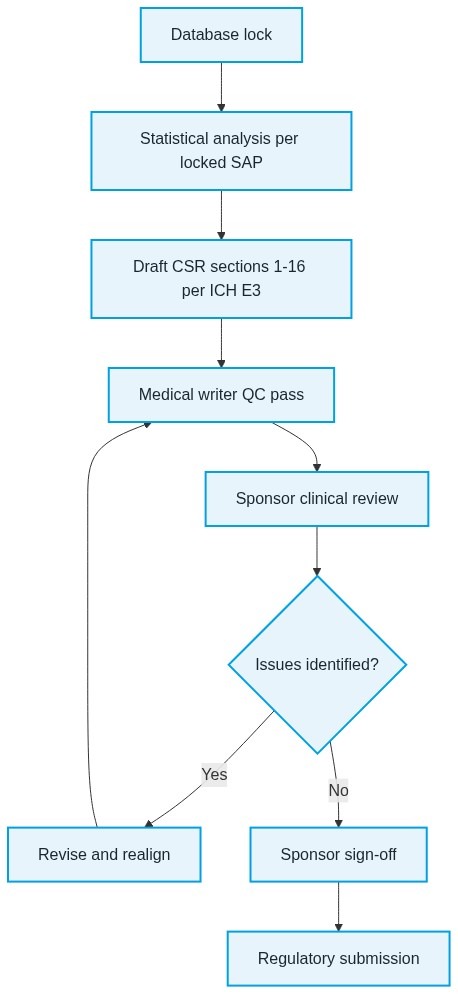
Flowchart — CSR writing process from database lock to regulatory submission, TD direction
Aligning narrative conclusions with statistical outputs
The most common single deficiency in submitted CSRs is the misalignment between narrative conclusions and statistical outputs. This occurs when the medical writer, the statistician, and the sponsor’s clinical lead work on separate sections without a structured cross-check before finalisation. As a result, the report states one conclusion in the narrative and shows different numbers in the table beneath it. Alternatively, the confidence intervals referenced in the text do not match those in the statistical analysis output.
The fix is procedural, not technical. Before the CSR goes for final review, the team must perform a dedicated table-narrative reconciliation pass. Every numerical claim in the text of Sections 11 and 12 must trace back to its source table or figure. For multi-site studies, the analysis population definitions in Section 10 must align with how the populations appear in the statistical tables. For studies that use multiple statistical analysis plans or interim analyses, the team must clearly describe the hierarchy of analyses and apply it consistently.
ICH E6(R3) came into effect for EMA in July 2025 and FDA adopted it in September 2025. Both agencies now place additional emphasis on data integrity documentation. For CSRs submitted to FDA or EMA after these dates, the statistical methods section should reference the sponsor’s quality management approach. This alignment with E6(R3)’s risk-based, quality-by-design principles is now expected by both agencies.
Appendices: What regulators expect to find
Incomplete appendices represent the second most common deficiency category in APAC CSR submissions. Although the main report sections receive the most attention during drafting, regulators expect to find complete supporting documentation. At minimum, the appendices must contain: the study protocol with all amendments in chronological order; the specimen case report form; and individual site ethics committee approval letters. The full investigator list with qualifications, any study-specific laboratory or analytical methods, and individual patient data listings for adverse events, serious adverse events, and efficacy endpoints are also required.
Country-specific approvals
For multi-country studies, a common failure is including the ethics approval letter for the coordinating site but omitting the country-level approvals for each participating APAC market. CDSCO submissions for Indian sites require the DCGI approval letter in the appendices. Australian sites under TGA require the TGA notification or clinical trial notification (CTN) reference. In Japan, PMDA requires the Clinical Trial Notification (CTN or Rinshoshiken Todokede) documentation. These are not optional. A CSR that arrives without the required country-specific approvals in the appendices will receive a deficiency notice on first review.
Protocol amendments are a specific failure point. When the sponsor amended the protocol during the trial, every amendment must appear in the appendices as its own document, dated and signed. If the main report describes a protocol change but the amendment document is absent from the appendices, the reviewer cannot confirm when the sponsor made the change. They also cannot verify that an ethics committee approved it before implementation.
Common CSR deficiencies in APAC regulatory submissions
Based on Credevo’s medical writing program across APAC markets, the most common deficiencies fall into five categories. Because these problems recur across submissions, understanding them at the planning stage is the most efficient way to avoid them at submission.
Synopsis-to-body inconsistencies
Any numerical result, conclusion, or descriptive statement in the synopsis that does not match the corresponding section of the main report triggers a deficiency notice. This is the single most common trigger. It is also the most preventable. A structured final review in which the team reads the synopsis line-by-line against the relevant tables catches this before submission.
Missing or incomplete patient narratives
Narratives that are templated, incomplete, or omit the clinical timeline for deaths and SAEs consistently draw scrutiny. PMDA is the strictest reviewer on this point. FDA and EMA also flag narrative quality. A clinician should review all narratives before finalisation, not just the medical writer.
Unstated or missing protocol amendments
Protocol changes occur during a trial and appear in the text, but the appendices omit the amendment documents. The main report must describe every amendment in Section 9 and cross-reference the appendix. The full amendment text must be in the appendix.
Analysis of population inconsistencies
The protocol and SAP define the full analysis set, per-protocol set, and safety population. However, the statistical tables sometimes apply these populations differently than the text describes. Reviewers use Section 10 and the statistical tables together. When the populations do not align, the data package cannot be interpreted.
Missing country-specific regulatory approvals in appendices
For multi-country APAC studies, teams frequently include only the coordinating-site ethics approval. Country-specific ethics and regulatory approvals for every participating market must appear in the appendices. For Credevo’s 13-market network, this is a standard checklist item at CSR initiation.
Planning your clinical study report writing timeline
The CSR writing process should begin before the database lock, not after. For a typical Phase II trial, the medical writing team should receive the final protocol and all amendments within five business days of database lock. The locked SAP and patient data listings should arrive on the same schedule. A realistic timeline from database lock to a first complete draft is six to ten weeks. The exact duration depends on study complexity, the number of sites, and the number of countries involved. When teams start later than this, the overall submission timeline extends accordingly.
The most common reason CSR timelines run over is that the medical writing team waits for the statistical output before beginning any drafting. However, the team can draft the background sections (Sections 7, 8, 9) from the protocol before the data are finalised. Similarly, the team can confirm and compile Section 6 (investigators and site list) and the ethics documentation (Section 5) while the statistical analysis runs. Starting the appendices checklist early avoids the last-minute scramble for country-specific ethics approvals that delay many submissions.
How Credevo manages the clinical study report production process
For sponsors using Credevo’s medical writing service, the same team that managed the trial produces the CSR end-to-end. Because the medical writers and the clinical operations team work in the same system, section-by-section data access is available from day one. Protocol history and site documentation are equally accessible from the outset. This reduces the information-gathering phase of CSR writing by two to three weeks compared with handing the project to an external writing team with no prior study involvement. Credevo’s CSR program covers all 16 ICH E3 sections, patient narratives, TLFs, and appendices compilation. The output is produced in alignment with FDA’s E3 guidance and the ICH E3 Q&A supplement (2012).
Sponsors who want to understand how protocol quality affects CSR writing complexity can refer to Credevo’s article on protocol writing in clinical trials. It covers the specific protocol elements that create downstream CSR problems when ambiguously drafted. For sponsors building quality management systems that integrate CSR standards into trial execution, quality by design in clinical trials provides the framework.
Conclusion
A clinical study report written in line with ICH E3 is not just a documentation requirement. It is the instrument through which a completed trial becomes a regulatory asset. The deficiencies that most often slow APAC submissions are not caused by bad data. They stem from document problems: inconsistent synopses, missing patient narratives, and incomplete appendices. Narrative conclusions that do not align with the statistical tables are equally common. These are all preventable with the right writing process and the right review structure. A team that starts the clinical study report before database lock avoids most of them entirely.
Do You Need a Regulatory-Ready Clinical Study Report?
If you have completed a clinical trial and need a CSR that meets ICH E3 standards, our medical writing team can manage the full process from database lock. We cover submissions to FDA, EMA, PMDA, CDSCO, HSA, TGA, and every other market in Credevo’s network. Please fill out the form below to connect with our team.
Frequently asked questions
What is the difference between ICH E3 and the ICH E3 Q&A supplement?
ICH E3, finalized in 1995, sets out the 16-section structure and content requirements for clinical study reports intended for regulatory submission. The ICH E3 Q&A supplement (R1), published in 2012, clarifies how to apply the guideline flexibly based on study type. For example, it explains how to handle the report structure for studies with unusual designs. It also clarifies when sections can be condensed or merged, and how to present data for studies that did not go to full analysis. There is no R2 of ICH E3. Both documents together constitute the current standard for CSR preparation.
Which APAC regulators accept an ICH E3-structured CSR?
All ICH-aligned regulators accept a CSR structured under ICH E3. This includes PMDA (Japan), TGA (Australia), HSA (Singapore), NPRA (Malaysia), CDSCO or DCGI (India), MFDS (South Korea), TFDA (Taiwan), DAV (Vietnam), and FDA Philippines. Each market may have additional requirements on top of the ICH E3 baseline. For instance, PMDA expects all patient narratives in both English and Japanese for certain study types. CDSCO similarly requires specific India-site ethics approvals in the appendices. Credevo’s medical writing team manages all market-specific additions as part of the CSR production process.
How long should an ICH E3 clinical study report be?
ICH E3 does not specify a page limit. The Q&A supplement notes that the core report body should be as concise as clarity allows. A standard Phase II or Phase III study typically runs 100 to 150 pages. Patient data listings, statistical outputs, and supporting documents are placed in appendices. Studies with multiple endpoints, large patient populations, or complex safety profiles will require longer reports. A report that runs significantly shorter than 100 pages is usually missing required content. One that runs significantly longer is typically including in the main body information that belongs in appendices.
What is the most common reason a CSR receives a deficiency notice from PMDA?
Based on Credevo’s experience with PMDA submissions, the most common deficiency triggers in a clinical study report are: incomplete patient narratives for deaths and SAEs, inconsistencies between the synopsis and the statistical results tables, and missing protocol amendment documents in the appendices. PMDA reviewers read the synopsis and patient narratives before the main body, so these sections are under the highest scrutiny. PMDA also frequently requests clarification when the analysis populations in Section 10 do not align precisely with the population definitions in the locked SAP.
Can one CSR be used across multiple APAC regulatory submissions?
Yes. This is the core purpose of the ICH E3 framework: to allow a single core CSR to be submitted to multiple ICH-aligned regulators without reformatting. Market-specific additions are handled as supplements or separate cover documents rather than changes to the CSR body. For example, a Credevo-written CSR for a study run across India, Malaysia, and Singapore would have a single ICH E3-structured core report, with separate appendices sections containing the CDSCO, NPRA, and HSA ethics approvals respectively, and any market-specific data supplements attached as labelled appendices.