
Full Service CRO APAC: A Sponsor’s Guide to Phase II to IV Clinical Trial Management
You are planning a Phase II oncology study across three APAC markets. The protocol is close to final. Now comes the part most sponsors underestimate: selecting a CRO model that gives you execution control without building infrastructure you do not have. A full service CRO APAC engagement hands you one accountable partner across every function, from IRB submission to clinical study report. The question is not whether to outsource. It is what that outsourcing relationship should look like.

This article walks through what full service CRO APAC delivery covers, how regulatory requirements across Asia-Pacific shape execution, and the practical differences between a strong partner and a well-priced one.
Key takeaways
- Full service CRO APAC delivery covers the entire trial lifecycle under one contract and one accountable partner. This spans protocol design, regulatory submissions, clinical execution, and the final clinical study report.
- The Asia-Pacific clinical trials market reached approximately USD 11 to 12 billion in 2024. It is projected to double by the early 2030s, driven by cost advantages, large patient populations, and maturing regulatory frameworks.
- ICH E6(R3) Good Clinical Practice sets a risk-based quality-by-design standard. It entered into effect at the EMA in July 2025 and at the FDA in September 2025. The strongest full service CRO APAC partners have already embedded it into their monitoring models.
- Regulatory requirements differ significantly across APAC markets. For example, a study spanning Singapore, India, and Thailand requires three separate IRB and regulatory submission tracks, each with different timelines and documentary standards.
- The clearest differentiator is a single senior project manager as the sponsor’s primary contact for the full study duration. This matters most when issues arise across multiple markets simultaneously.
- Sponsors should verify that feasibility outputs include realistic, conservative timelines rather than bid-optimistic projections. Monitoring plans should reflect actual site risk, not a default template.
What full service CRO APAC delivery covers
A full service CRO APAC engagement covers the entire clinical trial lifecycle under one contract. This includes feasibility and country selection, site identification and qualification, regulatory and ethics submissions, and protocol design support. It also covers study start-up, clinical execution and monitoring, data management, biostatistics, and the final clinical study report per ICH E3. Because one organisation owns each of these functions, sponsors avoid the handoff failures that occur when different vendors cover different phases.
However, the specific scope varies by CRO. For example, some providers deliver all functions internally, while others subcontract biostatistics or laboratory services to third parties. Subcontracting affects quality oversight and timeline predictability. Before selecting a partner, sponsors should confirm where internal delivery ends and subcontracting begins.
Standalone services versus full outsourcing
Not every sponsor needs this delivery model. Sponsors with strong internal clinical operations teams sometimes prefer a functional service provider (FSP) model. In this model, the CRO staffs specific functions within the sponsor’s own systems and SOPs. Full service delivery makes most sense when the sponsor lacks an in-house APAC operations team. It also suits sponsors whose study spans multiple markets with regulatory complexity, or who need a single accountability point for investor or board reporting.
For Phase II to IV studies in APAC, the most common reasons to choose full service over FSP are regulatory reach and local site networks. A CRO partner with active regulatory relationships across PMDA, CDSCO, HSA, DAV, and TGA brings access that most sponsors cannot replicate quickly. Building those relationships independently takes years. For more on the FSP model specifically, see how the FSP model works in Thailand.
Why APAC is the fastest-growing region for clinical trials
Asia-Pacific is the fastest-growing region for clinical trial activity. The APAC clinical trials market reached approximately USD 11 to 12 billion in 2024 (GlobalNewswire, 2021 baseline; market intelligence updates through 2026). It is projected to double by the early 2030s. Phase III studies contributed 53.97% of clinical trial management market revenue in 2025, with a projected CAGR of 9.12% through 2031 (Mordor Intelligence, 2025).
The growth reflects three structural advantages. First, patient populations across APAC markets are large and, in many therapeutic areas, less heavily recruited than those in North America or Western Europe. This means faster enrolment on comparable protocols. Second, site and investigator costs run significantly lower across core APAC markets, especially India, Thailand, and Malaysia. Third, several APAC regulators have accelerated their review processes for oncology, rare disease, and first-in-human studies over the past three years.
What sponsors gain by adding APAC to a multi-regional program
Multi-regional programs that include APAC markets typically complete enrolment 20 to 40% faster than equivalent programs limited to North America and Europe. This figure comes from comparative site performance data across Phase II and III programs. Because enrolment pace drives the entire trial timeline, faster recruitment in APAC directly reduces time to primary endpoint and time to regulatory submission.
Sponsors should note that results from APAC populations may face scrutiny at FDA and EMA. This happens when the study was not designed to address population diversity from the start. ICH E8(R1), the 2021 general principles for clinical studies, specifically addresses intrinsic and extrinsic factors that affect regional data applicability. A CRO with experience submitting dossiers to global regulators addresses these factors during the protocol design phase, not after enrollment closes.
How regulatory frameworks shape CRO selection across APAC markets
APAC is not a single regulatory environment. Japan operates under PMDA, with a 30-working-day review standard for clinical trial notifications. India’s CDSCO operates under the New Drugs and Clinical Trials Rules 2019 and subsequent amendments. Singapore’s HSA runs a distinct CTA process. Thailand’s FDA and Australia’s TGA have separate submission requirements for both ethics and regulatory review. Vietnam’s DAV, South Korea’s MFDS, Taiwan’s TFDA, and the Philippines’ FDA each add further regulatory tracks.
For a Phase II study running across three APAC markets, sponsors manage three separate regulatory submission tracks simultaneously. Therefore, the full service CRO APAC partner must have active, current regulatory relationships in all three markets. Published timelines often diverge from actual experience. A CRO that quotes the published review timeline without operational experience in that market is quoting the wrong number.
What ICH E6(R3) means for CRO quality standards
The ICH E6(R3) Good Clinical Practice guideline sets a risk-based quality-by-design standard that directly affects how CRO partners structure their monitoring and oversight models. ICH E6(R3) was finalised in 2023 and entered into effect at the EMA from July 2025 and the FDA from September 2025. Under this standard, sponsors conduct risk-based monitoring rather than defaulting to 100% source data verification. Consequently, CROs that have updated their monitoring frameworks to the R3 standard reduce the sponsor’s compliance risk and cut unnecessary monitoring costs.
Sponsors should ask prospective CRO partners directly: does your monitoring plan default to 100% SDV, or does it reflect risk-based monitoring per ICH E6(R3)? A monitoring plan that treats every data point as equally high-risk is a red flag. It signals that the CRO has not updated its operating model to the current standard.
What start-up looks like with a full service CRO
Study start-up for a full service CRO APAC engagement covers four sequential activities: feasibility, regulatory and ethics submission, site contracting, and site initiation. In practice, experienced CRO partners run feasibility and site contracting in parallel where possible. Sequential execution adds weeks to the start-up timeline without reducing regulatory risk.
Feasibility and site identification
Country feasibility for a Phase II to IV study assesses disease epidemiology, patient availability, and site and investigator readiness. It also covers competing study load, vendor landscape, and realistic regulatory timelines. The output should be a specific recommendation: which markets to include, which to defer, and why. A generic APAC comparison table does not help a sponsor make a decision.
When sponsors select sites based on feasibility questionnaires alone, they frequently discover that site commitments do not survive first patient enrolment. Early investigator engagement means the CRO engages principal investigators before the protocol is final. This surfaces whether the standard of care assumed in the comparator arm reflects what investigators actually use. It also confirms whether the target patient population is accessible at the proposed sites. Problems identified at feasibility cost days to fix. In contrast, the same problems identified during execution cost months.
Regulatory and ethics submission timelines
The regulatory and ethics submission phase for a multi-country APAC study typically runs eight to eighteen weeks from protocol finalisation to approvals. The exact range depends on the countries in scope and the complexity of the study design. India’s CDSCO operates a scientific committee review for Phase II and III studies. Japan’s PMDA notifies within 30 working days for standard protocols. Singapore’s HSA runs a concurrent regulatory and ethics process at most accredited sites.
A full service CRO APAC partner tracks these timelines actively and manages deficiency responses without requiring sponsor involvement on individual documents. Where regulatory bodies raise deficiencies, experienced CROs have responses to common queries. As a result, they can reduce the back-and-forth time significantly.
How monitoring, data management, and safety oversight run
For a full service CRO APAC study, clinical monitoring, data management, and safety oversight run as integrated functions. The site monitor, data manager, and medical monitor share the same source of truth. That is the EDC system the sponsor selected and the risk signals the CRO’s central oversight team tracks.
Risk-based monitoring per ICH E6(R3) concentrates site visit activity at sites and time periods with elevated risk signals. Because the CRO manages both monitoring and data management internally, risk signal detection is faster. Separate vendors managing different functions would slow that identification.
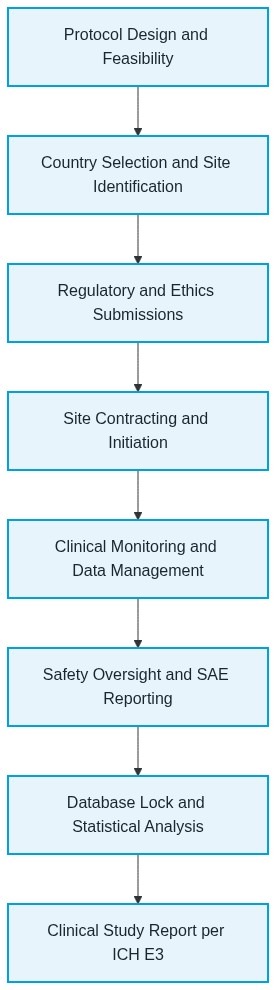
Figure 1: Trial lifecycle from protocol design to CSR under a full service CRO APAC engagement. Timeline varies by market and study complexity.
Safety oversight and adverse event reporting
Safety oversight runs from first patient consent through to CSR filing. The medical monitor reviews all adverse events and serious adverse events (SAEs), assesses causality, and manages expedited reporting to regulatory bodies where required. APAC markets have different SAE reporting timelines. Japan’s PMDA requires 15-day reporting for unexpected SAEs. India’s CDSCO follows a 15-calendar-day standard for serious unexpected adverse drug reactions. A full service CRO APAC partner with active regulatory relationships ensures that safety reporting meets each market’s requirements.
From database lock to clinical study report
Database lock triggers the final phase of the engagement. This covers statistical analysis, tables, listings, and figures (TLFs), and the final clinical study report (CSR) per ICH E3. The CRO writes and locks the statistical analysis plan (SAP) before the first patient enrolls, per ICH E9. When post-execution amendments require SAP updates, the CRO documents the rationale and confirms the amendment does not introduce bias into the analysis.
For sponsors planning a multi-regional filing after the APAC study, the CSR must include the regulatory appendices each target agency expects. These include regional patient data summaries and country-specific tables. A CRO experienced in multi-regional submissions builds these into the CSR template from the start. Retrofitting them after the main report is written adds weeks and costs money.
[VISUAL: comparison table showing regulatory submission timeline ranges for Singapore, India, Thailand, Japan, and Australia, with approximate weeks from protocol final to first patient in for a standard Phase II study]
What distinguishes a strong full service CRO APAC partner
The strongest full service CRO APAC partners share several characteristics. They provide a single senior project manager as the sponsor’s primary contact for the full study duration. Country-level teams handle execution on the ground, but accountability concentrates at one person. As a result, sponsors do not chase different markets for updates. For more on execution standards across multi-country APAC programs, see mastering clinical operations in Asia-Pacific.
Strong CROs give honest feasibility assessments. When the fastest regulatory pathway is in Singapore but the right patient population is in India, a genuine partner says so. It does not propose both markets just to maximise contract value. Conservative timelines that survive execution are worth more than optimistic ones that slip in Month 3. Since honest assessment saves time and money, it is a practical advantage, not just a virtue.
For sponsors comparing proposals, four questions matter most. Who is the named senior project manager and what is their direct APAC experience? Which functions does the CRO deliver internally versus subcontract? What does the CRO’s monitoring framework look like under ICH E6(R3)? What are the actual approval timelines the CRO has achieved in target markets within the past 24 months, not the published regulatory timelines?
Conclusion
A full service CRO APAC engagement is the right model for sponsors who need multi-country execution without building an in-house APAC operations team. APAC’s regulatory complexity, site diversity, and enrolment advantages all become operational assets when the CRO partner has genuine local presence. The difference between a fast trial and a stalled one comes down to decisions made before the first patient is screened. Feasibility depth, regulatory submission preparation, and monitoring planning are where that difference is made. Choose the partner who gets those right.
Planning a Phase II to IV Study in APAC With a Full-Service CRO?
If you are scoping a Phase II to IV study across APAC markets, Credevo can walk you through it. We provide a realistic view of regulatory timelines, site options, and what full service CRO delivery looks like in practice. Please fill out the form below to connect with our team.
Frequently asked questions
What does a full service CRO APAC engagement include?
A full service CRO APAC engagement covers the complete clinical trial lifecycle under one contract. The scope includes country feasibility and site selection, and regulatory and ethics submissions across all markets. Study start-up covers protocol design support, CRF development, and SAP preparation. It also covers clinical execution (monitoring, data management, safety reporting) and study closeout (database lock, statistical analysis, TLFs, and final CSR per ICH E3). The sponsor contracts with one partner and has one primary contact who is accountable for all functions across all markets. Since scope varies by CRO, sponsors should confirm which functions the CRO delivers internally and which it subcontracts.
How long does regulatory approval take for a Phase II study in APAC?
Regulatory approval timelines vary significantly across APAC markets. Japan’s PMDA issues a clinical trial notification response within 30 working days for standard protocols, with longer timelines for complex or first-in-human studies. Singapore’s HSA concurrent regulatory and ethics process typically completes within 8 to 12 weeks for moderate-complexity studies. India’s CDSCO review for Phase II studies runs 12 to 18 weeks on average, depending on therapeutic area and study complexity. Thailand’s FDA and Australia’s TGA have their own distinct requirements. A CRO partner with recent experience in your target markets gives you conservative, realistic timelines rather than published best-case figures.
Is a full service CRO better than an FSP model for APAC trials?
The right model depends on your internal capabilities. A full service CRO APAC engagement suits sponsors who lack an internal APAC operations team and need one accountability point across multiple markets. It also suits sponsors running a Phase II to IV study that requires regulatory expertise across several countries simultaneously. In contrast, an FSP model suits sponsors with strong internal clinical trial management capacity. They use the CRO to staff specific functions within their own systems and SOPs. For most first-time or early APAC sponsors, full service delivery is the lower-risk model because it places local knowledge and regulatory relationships with the CRO.
What regulatory framework does a full service CRO APAC partner operate under?
Full service CRO APAC partners operate under the regulatory frameworks of each market in scope, alongside international standards. The primary GCP framework is ICH E6(R3), final in 2023 and in effect at the EMA from July 2025 and the FDA from September 2025. Study design follows ICH E8(R1), the 2021 general principles for clinical studies. Statistical analysis follows ICH E9. The CSR follows ICH E3. In Singapore, the HSA framework applies. India uses CDSCO NDCT Rules. Japan follows PMDA notifications. Equivalent requirements govern Thailand, Vietnam, Malaysia, Australia, and the other markets where Credevo operates.
How do sponsors evaluate full service CRO APAC proposals?
When comparing full service CRO APAC proposals, focus on four areas. First, verify the CRO has direct, current regulatory relationships in your target markets, not just general APAC coverage. Second, confirm which functions the CRO delivers internally and which it subcontracts, including biostatistics, central lab, and imaging. Third, ask for the actual approval timelines the CRO has achieved in your target countries within the past 24 months. Fourth, ask who the named senior project manager will be and what their direct APAC experience covers. A CRO that cannot answer these questions specifically is proposing a model, not a track record.