
Real-World Evidence (RWE) Studies in APAC: Regulatory Pathways, Site Qualification, and Key Considerations Before Protocol Finalization
Sponsors running real-world evidence studies in APAC face a different planning challenge from those running interventional trials. The study design is not the primary source of complexity. The data infrastructure is. So is each market’s regulatory acceptance posture and the site capability to manage observational methodology.
Sponsors who treat the APAC region as a single real-world data environment encounter the same problems repeatedly. Data that appeared available during scoping turns out to be fragmented. Regulators who accepted a similar design in one market decline it in another. Sites that ran Phase III trials well lack the systems and investigator experience that non-interventional research requires. These problems are avoidable with the right planning sequence.
This guide covers what sponsors need to resolve before the protocol is written.
Key takeaways
- Real-world evidence studies differ from interventional trials in ways that affect planning, site selection, and regulatory submission. Sponsors who treat them as lower-complexity do not complete fewer steps; they complete different steps, and those steps must happen earlier.
- The ICH M14 guideline reached Step 4 in September 2025, setting a new global standard for planning and reporting non-interventional safety studies that use real-world data. APAC regulators in ICH-member markets are expected to implement it. Sponsors planning new real-world evidence studies should design to M14 requirements from the outset.
- Japan’s PMDA has the most developed RWE regulatory framework in APAC. Approximately 30% of drug approvals in Japan in 2024 incorporated real-world data or evidence in some form. Sponsors who exclude Japan from an RWE programme based on complexity assumptions may be reacting to the interventional trial experience rather than the observational one.
- India’s CDSCO does not yet have a formal study design taxonomy for real-world evidence studies equivalent to FDA guidance or ICH M14. This does not prevent studies in India, but it increases the importance of pre-submission engagement before the protocol finalises.
- Data source qualification is frequently the rate-limiting step in APAC RWE planning. EHR completeness, claims linkage, and registry coverage all vary by market and therapeutic area. Assessing data fit before protocol lock is where sponsor time is best spent.
- Site qualification for real-world evidence studies requires criteria that differ from those used for interventional trial sites. Investigator experience with observational methodology, data governance infrastructure, and IRB familiarity with non-interventional consent frameworks are all material variables.
What real-world evidence studies require before the protocol is written
Real-world evidence studies use data generated outside of randomised controlled trials. Common sources include electronic health records, insurance claims, disease registries, and patient-reported outcomes collected in routine care. The purpose ranges from post-marketing safety surveillance to comparative effectiveness research to studies where randomisation is impractical.
In an interventional trial, the sponsor defines the data by designing the study. In real-world evidence studies, the data already exists. The sponsor must assess whether it is adequate, complete, and fit for the regulatory question. This reversal of the design sequence changes the planning timeline. Most consequential decisions in a real-world evidence study must be made before protocol finalisation, not during it.
Why the ICH M14 guideline changes the planning baseline
The ICH M14 guideline reached Step 4 of the ICH process in September 2025 and entered the implementation phase. It sets general principles for planning, designing, analysing, and reporting non-interventional studies that use real-world data. APAC regulators in Japan, Singapore, and other ICH-member markets are expected to implement it.
Two M14 requirements are particularly relevant to APAC planning. First, M14 calls for a feasibility assessment of data sources before study design is finalised. This assessment must evaluate whether real-world data in target markets can support the study’s objectives. Completeness, representativeness, and linkage capability must all be confirmed. Second, M14 recommends early regulatory engagement when real-world data will support regulatory submissions. Sponsors who begin design without this assessment are building on assumptions that M14 now expects to be verified.
The feasibility assessment that precedes everything else
A regulatory feasibility assessment for a real-world evidence study covers different ground from one for an interventional trial. For an interventional trial, the primary questions are whether target markets have eligible patients and capable sites. For real-world evidence studies, those questions remain. A third dimension is added: whether data sources in each market are structured, complete, and accessible in a form that supports the proposed design.
This assessment must happen before the study design is finalised. If EHR data in a target market is incomplete for the relevant diagnosis codes, the study design must change to reflect reality. If claims data does not capture the outcomes being measured, the design must adjust before the protocol is written. Discovering these gaps after submission is substantially more expensive than discovering them before.
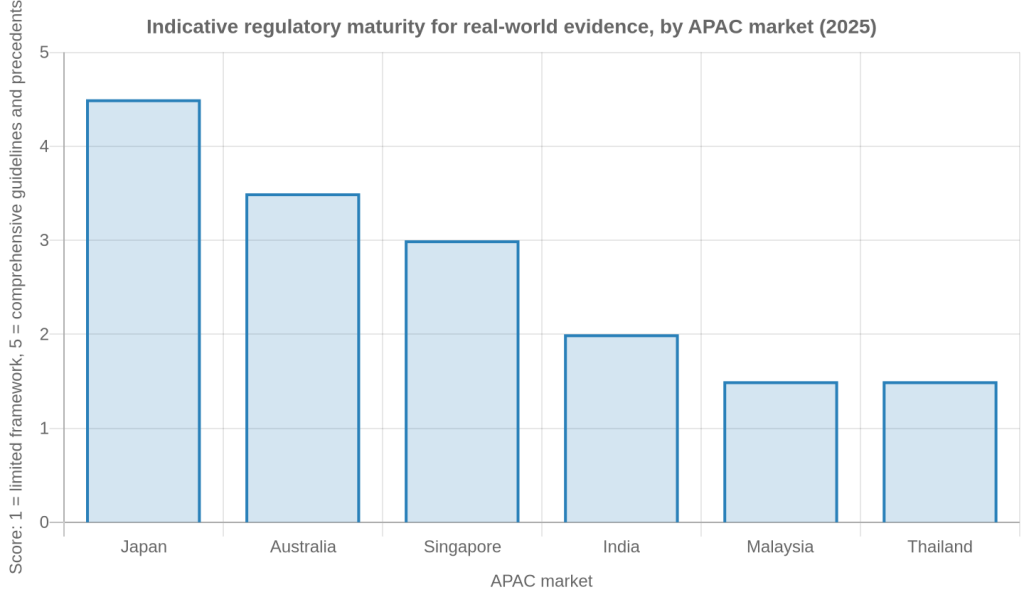
Indicative regulatory maturity for real-world evidence acceptance by APAC market. Ratings are based on published guideline infrastructure, scientific advice programme availability, and known regulatory precedents as of 2025. They should not be used as a proxy for study feasibility in any specific therapeutic area.
Regulatory acceptance of RWE by APAC market
The APAC region does not have a uniform regulatory framework for real-world evidence studies. Each market has its own acceptance posture, guideline infrastructure, and submission expectations. Applying a regional template rather than a market-by-market assessment is one of the most common planning errors in APAC RWE programmes.
Japan: the most developed RWE framework in APAC
Japan’s PMDA has issued four guidelines addressing the use of real-world data in regulatory submissions. These cover registry-based studies, database studies, and the use of RWE as external control arms. PMDA has operated a scientific advice programme for registry and database-based studies since 2019. This programme allows sponsors to engage the regulator before study design is finalised.
In 2024, approximately 30% of drug approval submissions in Japan incorporated real-world data or evidence in some form. This makes real-world evidence studies a viable regulatory pathway in Japan across a meaningful range of use cases. Sponsors should note, however, that most PMDA acceptance of RWE at the primary evidence level is concentrated in rare disease and paediatric settings. For standard populations, RWE in Japan is most accepted for post-marketing safety obligations and supportive comparative effectiveness data.
Singapore, India, Malaysia, and Thailand: diverging frameworks
Singapore’s HSA does not yet have a formal published framework specifically for RWE study design and submission. HSA has developed guidance on decentralised clinical trial elements and electronic consent. These overlap with some of the technology infrastructure relevant to RWE designs. Sponsors planning real-world evidence studies in Singapore should engage HSA through scientific advice before finalising the protocol.
India’s CDSCO is at an earlier stage. The regulatory framework for real-world evidence studies in India does not yet include a formal study design taxonomy. CDSCO recognises real-world data in pharmacovigilance and post-marketing surveillance contexts. The framework for prospective non-interventional studies intended to generate RWE for regulatory submissions is still developing. Sponsors with a regulatory submission objective in India should plan for pre-submission engagement and should not assume that accepted practice in Japan transfers automatically.
Malaysia and Thailand currently have less developed frameworks for RWE regulatory acceptance. Real-world data is used primarily for pharmacovigilance submissions in both markets. For studies where RWE will support a regulatory decision, sponsors should treat Malaysia and Thailand as markets where the pathway must be negotiated rather than referenced against a published framework.
Data source qualification in APAC: what fits and what does not
Data source qualification determines whether a specific real-world data source can support the study’s objectives and regulatory requirements. In APAC, this step is frequently where planning breaks down. Sources that appear relevant during initial scoping often turn out to be incomplete, not linkable to outcomes, or not representative of the population being studied.
EHR, claims, and registry data in APAC: the infrastructure gaps
EHR coverage varies substantially across APAC. Japan has centralised EHR platforms and stable patient follow-up systems. This makes longitudinal data capture reliable for studies that require outcome ascertainment over time. Singapore operates a national electronic health record system with cross-institution linkage. This positions it as one of the stronger EHR environments in the region for observational research.
India has significant variation across institutions. Hospital-level EHR adoption exists at major academic and research centres, but interoperability and completeness are inconsistent outside that tier.
A targeted literature review published in 2025 identified 33 unique oncology real-world data sources across the Asia Pacific region. These included electronic health records, administrative databases, and medical claims databases. The review found that coverage, linkage capability, and completeness varied substantially by market and source. The recommendation was that sponsors assess each source for fitness before committing it to a study design.
Primary data collection as an APAC alternative
Where secondary data sources do not meet fit-for-purpose criteria, sponsors can supplement or replace them with primary data collection. This approach uses structured case report forms, sponsor-established patient registries, or hybrid designs that combine secondary data with prospectively collected elements. Primary collection provides greater control over data completeness and variable definition. For clinical operations teams working across APAC, primary data collection in real-world evidence studies should be planned as a distinct workstream. Site activation, training, and data governance requirements are all different from those of an interventional trial.
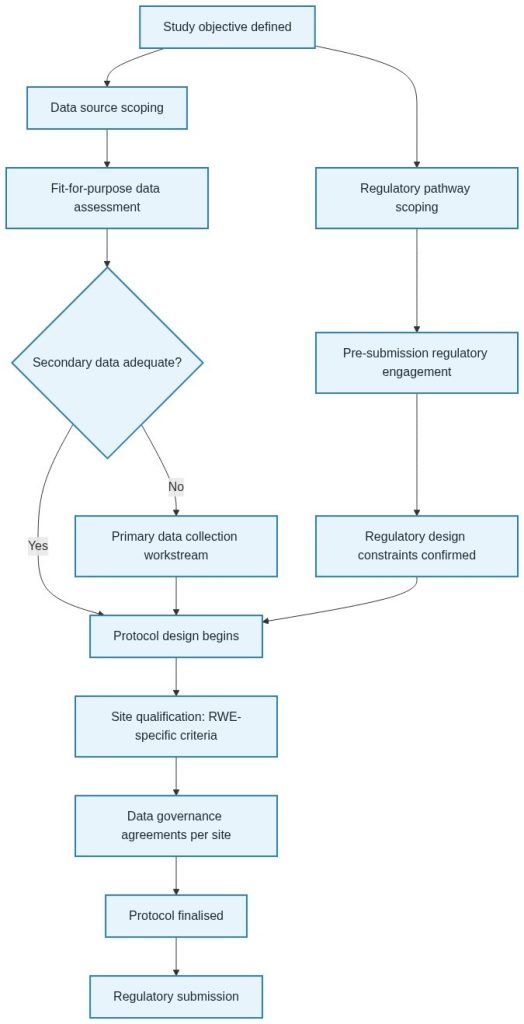
Pre-protocol planning pathway for real-world evidence studies in APAC. The data source assessment and regulatory engagement branches should run concurrently before protocol finalisation. Both inform protocol design. Studies where secondary data fails the fit-for-purpose assessment require either a primary collection workstream or a revised market selection before the design proceeds.
Site qualification for real-world evidence studies: what differs from interventional trials
A site that performed well in an interventional Phase III trial may not be the right site for a real-world evidence study. The qualification criteria overlap in some areas. Patient volume in the relevant therapeutic area matters. Investigator GCP experience matters. In other areas, the requirements differ materially. Using an interventional trial qualification template without adaptation is a common source of site-selection errors in APAC RWE programmes.
Observational methodology experience at the site level
Investigators leading real-world evidence studies need experience with observational research methods. This means understanding exposure classification in routine data, outcome ascertainment using administrative records, and confounding control approaches. It also means familiarity with the documentation practices required for a non-interventional study dossier. Sites that have conducted pharmacoepidemiological or registry-based research are significantly better positioned. Site qualification should include a specific assessment of prior observational or registry-based research activity at each candidate site.
Data governance and IRB considerations
Real-world evidence studies frequently involve access to existing patient data. This creates data governance requirements that differ from those of interventional trials. Data access agreements, de-identification standards, and institutional approval processes for secondary data use vary by market and institution. In Japan, institutional review boards have established processes for registry and database studies. In India, IRB review of non-interventional studies that use existing patient data is evolving. Consent requirements depend on the data source and study design.
Sponsors should complete a data governance assessment for each target site before the protocol is finalised. This assessment should confirm the applicable consent framework, what institutional data access agreements are required, and whether the site’s data infrastructure can support the sponsor’s quality and audit trail requirements. Sites that cannot confirm these elements during qualification present schedule risk if retained without resolution.
Key decisions to resolve before protocol finalization
Real-world evidence studies accumulate design complexity early. The decisions made before protocol finalisation determine whether the study generates evidence that regulators and ethics committees will accept. Several of these decisions cannot be reversed without a formal protocol amendment after submission.
Regulatory engagement timing and its impact on design
ICH M14 recommends early regulatory engagement for real-world evidence studies intended to support regulatory submissions. Regulators in Japan, Singapore, and other markets hold specific positions on study design elements. Comparator selection, confounding adjustment methodology, and outcome definition are all areas where regulatory views differ. Discovering a misalignment after the protocol is finalised requires either an amendment or a risk accepted in the submission. Pre-submission scientific advice raises these questions before they become constraints.
Regulatory engagement timing also affects market selection. If a target market’s regulator will not accept a specific design for a specific use case, it is better to know this during planning than during review. Sponsors who wait until a study is complete to assess regulatory acceptance in each market face a clear risk. A design optimised for one regulatory environment does not automatically transfer to another.
The fit-for-purpose data assessment
The fit-for-purpose assessment evaluates whether each data source can support the study’s primary objectives. It covers four dimensions. Completeness asks whether the relevant variable is captured consistently across the data source. Representativeness asks whether the patient population in the data source matches the study’s target population. Validity asks whether diagnostic codes and clinical measurements are accurate enough to define exposures and outcomes reliably. Timeliness asks whether the data source covers the time period the design requires.
Running this assessment before protocol finalisation means the protocol can be written around the data that is actually available. Skipping it and designing around assumed data availability is the most consistent source of preventable delay in real-world evidence studies across APAC markets. Addressing the data fit question early places the study on a realistic foundation.
Conclusion
Real-world evidence studies in APAC require planning decisions that precede the protocol. Regulatory frameworks are not uniform across the region. Data infrastructure varies significantly by market and institution. Site qualification for observational methodology is a distinct assessment from interventional trial readiness. Sponsors who address these questions systematically before protocol finalisation are better positioned to generate evidence that regulators accept and that site teams can execute on schedule.
Planning a Real-World Evidence Study in APAC?
Credevo supports sponsors across 13 APAC and US markets with regulatory strategy, site and data feasibility assessments, and execution for both interventional and non-interventional programmes. If you are scoping a real-world evidence study and want to map the regulatory, data, and site landscape before the protocol is written, reach out to the team: credevo.com/contact.
Frequently asked questions
What distinguishes a real-world evidence study from a standard observational study?
The terms are often used interchangeably, but the distinction matters in a regulatory context. An observational study is any study that does not assign interventions prospectively. Real-world evidence studies are observational studies that use data generated in routine clinical care as their primary data source. The characteristic that matters for regulatory purposes is where the data comes from and how it was generated, not the study label.
ICH M14 uses the term “non-interventional studies that utilise real-world data” to define the scope of its guidance. Sponsors planning studies that use EHR, claims, or registry data should assess their designs against M14 principles. This applies regardless of which label they attach to the design type.
Which APAC markets are most advanced in accepting RWE for regulatory submissions?
Japan has the most developed regulatory framework for real-world evidence in APAC. PMDA has published four guidelines on real-world data use and operates a scientific advice programme for registry and database studies. In 2024, approximately 30% of drug approval submissions incorporated RWD or RWE. Most acceptance at the primary evidence level is concentrated in rare disease and paediatric settings. Singapore and Australia have more developed environments for RWE than India, Malaysia, or Thailand. India’s CDSCO framework is still emerging.
Can real-world evidence studies in APAC draw data from multiple countries?
Multi-country real-world evidence studies are feasible but require careful data governance planning. Each market has its own data protection framework, consent requirements for secondary data use, and institutional approval processes. The sponsor must establish data access agreements at the institution level in each market. Data transfers across jurisdictions must be confirmed as permissible under applicable privacy law. Data from different markets must also be assessed for compatibility before combining them in a common data model. These requirements should be addressed during feasibility, before the protocol commits to a multi-country data strategy.
How does site qualification for an RWE study differ from interventional trial site qualification?
Both types of qualification assess patient volume, investigator commitment, and site infrastructure. Real-world evidence studies add requirements that interventional trials do not emphasise as heavily. Investigator experience with observational methodology matters for exposure classification, outcome ascertainment, and confounding adjustment decisions. Data governance infrastructure matters because the study depends on institutional data under formal access agreements. IRB experience with non-interventional consent frameworks matters because the consent pathway for a retrospective database study differs from standard informed consent.
Sponsors should use a site qualification questionnaire developed specifically for observational and real-world evidence study designs, rather than adapting an interventional trial template without modification.
When should a sponsor engage regulators for a real-world evidence study in APAC?
ICH M14 recommends early regulatory engagement for real-world evidence studies intended to support regulatory submissions. For APAC programmes, this means engaging before the protocol is finalised. In Japan, PMDA’s scientific advice programme for registry and database studies is the appropriate channel. It is available from early in the design process. In Singapore and India, pre-submission engagement with the relevant authority should be planned for any study where RWE output will support a regulatory decision.
The specific timing and format of engagement varies by market and study type. Sponsors should confirm the engagement pathway for each target market during feasibility. Regulatory timelines should be built into the protocol development schedule, not added to it after the design is committed.