
Five Things Sponsors Assume About APAC Regulatory Timelines That Turn Out to Be Wrong: A Market-by-Market Reality Check
Most sponsors enter APAC planning with a set of mental shortcuts. Singapore is the gateway. Japan is too slow. India’s 90-day rule means India is fast. Ethics approval runs in parallel and takes care of itself.
These assumptions are reasonable on the surface. However, each one creates timeline risk that compounds across markets.

The gap between expected APAC regulatory timelines and actual first-patient-in dates ranges from eight weeks to more than six months. A sponsor who builds a 12-month trial plan using statutory clocks as actuals will face a re-plan. The five assumptions below are the ones that cause it most often.
Key takeaways
- Singapore’s Health Sciences Authority (HSA) approval does not create any regulatory shortcut in other APAC markets. Each country requires an independent submission with its own dossier format and review process.
- Statutory review clocks in Japan and India start after dossier acceptance, not on the submission date. The acceptance phase can add two to four weeks before the review clock begins.
- Japan’s PMDA clinical trial notification (CTN) review standard is 30 working days, which is faster than India’s statutory minimum. Sponsors who exclude Japan based on perceived regulatory speed are reacting to outdated assumptions.
- India’s 90-day NDCT timeline covers only the central CDSCO review. Institutional ethics committees at each participating site run in series after central approval and can add months to the critical path.
- In Malaysia and Thailand, ethics submission cannot proceed until regulatory approval is in hand. Treating ethics as a parallel track in these markets typically adds 8 to 16 weeks of unplanned delay.
- APAC regulatory timelines rarely behave as their statutory descriptions suggest. Feasibility planning should use observed site-level timelines, not published statutory windows.
Assumption 1: get Singapore approval and the rest of APAC follows
Singapore occupies a well-earned reputation as the fastest, most predictable regulatory market in the region. HSA runs a concurrent regulatory and ethics process that completes in 8 to 12 weeks for moderate-complexity studies. For many sponsors, Singapore is the first stop. The assumption that follows is that HSA approval signals something useful to other APAC regulators.
It does not. No formal mutual recognition agreement for pharmaceutical clinical trial applications currently exists between Singapore and India, Japan, Malaysia, or Thailand. HSA approval tells another regulator nothing about whether it will approve the same trial. Each country runs an independent assessment, with its own requirements, its own dossier format, and its own timeline. Because sponsors regularly plan multi-market submissions as if HSA clearance accelerates the process elsewhere, this assumption creates delays that surface during submission preparation rather than during planning.
What Singapore approval does and does not cover
An HSA-approved protocol is a strong starting point for dossier preparation in other markets, because the core science is already reviewed. However, CDSCO in India requires a Form CT-04 submission, compliance with the NDCT Rules 2019, and institutional ethics committee approval at each site. PMDA in Japan requires a clinical trial notification in Japanese, with a separate IRB process. Neither regulator accepts HSA approval as a substitute for its own review process.
The structural reality is that APAC is not a single regulatory zone. Each market has a sovereign process. Sponsors who treat it otherwise typically discover this when the clinical team has already committed to a 12-month timeline and the regulatory team begins preparing country dossiers.
How to plan around this from the start
A regulatory feasibility assessment at protocol-lock stage maps each target market’s submission requirements before the team commits to a timeline. Because APAC regulatory timelines differ by country and ethics-track structure, the assessment should cover both tracks separately. A few weeks spent at this stage prevents re-plans that cost months later.
Assumption 2: the statutory review window is the actual review window
Statutory APAC regulatory timelines are the best-case scenario. Japan’s PMDA operates a 30-working-day CTN review standard. India’s CDSCO has a 90-working-day ceiling under the NDCT Rules 2019. These numbers appear in planning tools, CRO proposals, and sponsor timelines as fixed durations. They are not fixed, and they do not start when sponsors assume they do.
The statutory clock starts on the day the regulator formally accepts the dossier for review. That is not the submission date. Most regulators run a screening phase first, during which they check whether the dossier is complete. CDSCO’s SUGAM portal has a known pattern of technical rejections during upload. PMDA’s screening for CTN submissions includes a completeness check before the 30-day window opens. Sponsors who count the statutory window from submission day are counting from the wrong point.
When the clock actually starts
At CDSCO, the acceptance phase can take two to four weeks after initial submission. SUGAM portal issues, including file-size limits, format requirements, and system timeouts, add further delay before the dossier is confirmed as received. The 90-day statutory ceiling begins only after these hurdles are cleared.
At PMDA, the screening phase for CTN submissions is typically shorter. However, deficiency queries during the 30-day review period pause the clock. PMDA may request clarification on any aspect of the protocol. The clock resumes only when the sponsor responds to PMDA’s satisfaction. A single deficiency round adds three to six weeks in practice.
Deficiency queries: the hidden time multiplier
Both CDSCO and PMDA use deficiency queries routinely. Because the clock pauses for each query-response cycle, sponsors who do not plan for at least one deficiency round per market will underestimate total regulatory time. A well-prepared dossier reduces the probability of queries but does not eliminate it. The baseline plan for every APAC submission should include one deficiency round per market as a standard assumption. Do not treat the statutory window as a reliable ceiling until site-level data from recent submissions in that market confirms it.
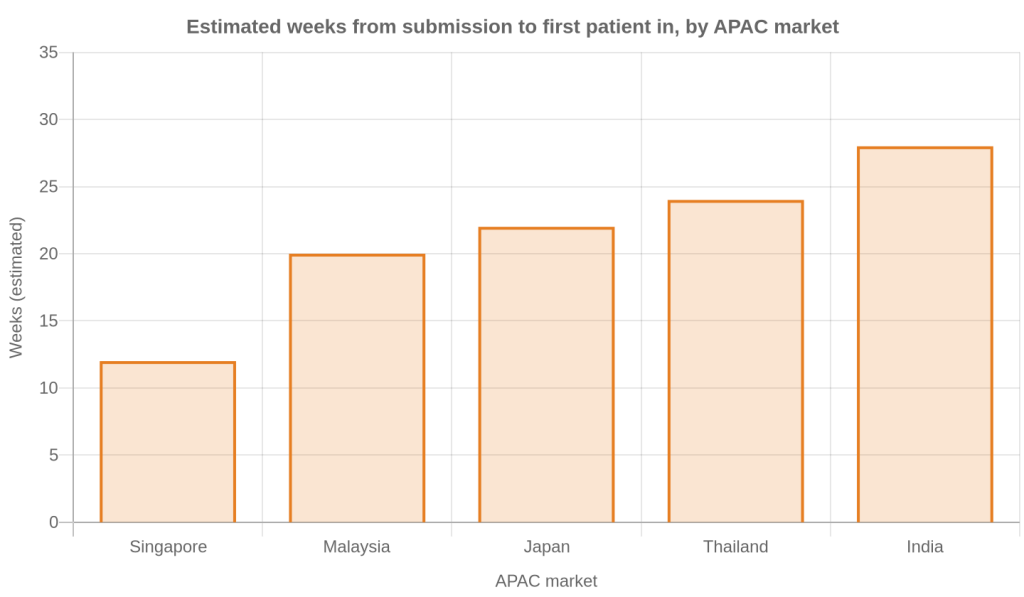
Estimated typical weeks from regulatory submission to first patient in, by APAC market. Values include regulatory review, ethics approval, and site initiation phases. Timelines are estimated based on observed experience and vary by study complexity, therapeutic area, and site readiness.
Assumption 3: Japan’s PMDA timeline makes it too slow to include
Japan carries a reputation as the most complex and slowest APAC market for clinical trial initiation. Part of this is historical. Before the regulatory reforms of 2014 and 2019, Japan required trials to be conducted separately from global studies, with Japanese-language dossiers and lengthy review cycles for new drug applications. Some complexity remains. The CTN timeline is not one of the problems.
Japan’s PMDA CTN review standard is 30 working days. At five working days per week, that is six calendar weeks. CDSCO’s statutory minimum is 90 working days, which is three times as long. Singapore’s concurrent process runs 8 to 12 weeks total. On a straight comparison, Japan’s regulatory clock is among the shorter ones in the region, not the longer ones. Sponsors who exclude Japan from a global programme based on PMDA speed assumptions are optimising for the wrong variable.
The 30-working-day CTN: what it covers
The PMDA CTN applies to Phase I, II, and III studies conducted at Japanese sites under GCP compliance. The notification does not require PMDA pre-approval in the same way that a new drug application does. The sponsor files the CTN, Japan’s PMDA reviews it within 30 working days, and the trial can proceed if no objection is raised. Sponsors must comply with ICH efficacy and GCP guidelines and Japanese GCP regulations. The regulatory clock itself, however, is shorter than most sponsors’ planning documents reflect.
What actually slows Japan trials
The genuine challenges in Japan are site readiness, protocol adaptation, and IRB timing. Japanese clinical trial sites operate under institutional processes that extend initiation timelines. IRB approvals require full protocol translation and institutional review. Site budget negotiations are detailed and often slow. These are operational and site-level challenges, not regulatory ones.
The clinical operations landscape in APAC is frequently more site-specific than regulator-specific. Japan is a clear example of this. Sponsors who add Japan based on accurate regulatory data and manage the site-level challenges directly tend to find it a high-quality, high-enrolment market.
Assumption 4: India’s 90-day NDCT rule does not guarantee predictable APAC regulatory timelines
The 2019 New Drugs and Clinical Trials (NDCT) Rules brought genuine improvement. Before these rules, CDSCO reviews could extend indefinitely. The 90-working-day ceiling introduced structure and accountability. Sponsors rightly view this as progress. However, the assumption that India now offers predictable APAC regulatory timelines does not hold when you look at what the 90-day window actually covers and what it does not.
The 90-working-day ceiling applies to the central CDSCO review only. It does not cover the SUGAM portal acceptance phase, the institutional ethics committee (IEC) review at each trial site, or the gap between CDSCO approval and final IEC completion at all sites. In a multi-site India study, the IEC at every participating site must independently approve the protocol. These reviews do not run in parallel with each other. Each site’s IEC follows its own meeting schedule.
What the 90-day clock does and does not cover
CDSCO’s 90 working days cover the central regulatory review only. Before that clock starts, the sponsor must submit via SUGAM, clear portal-level validation, and receive formal dossier acceptance. After the clock ends and CDSCO grants approval, the sponsor still needs IEC approval from every site. Indian regulations require both CDSCO approval and institutional IEC approval before a site can enrol patients.
In practice, a sponsor targeting five Indian sites should plan for the CDSCO central review followed by a separate IEC process at each site. IEC meetings at major research sites typically occur monthly. If the dossier arrives between meetings, the next review date may be four to six weeks away. Five sites, five independent IEC processes, each on its own monthly schedule, can extend site activation by three to five months beyond the CDSCO approval date.
Site-level ethics: the overlooked multiplier in India
Sponsors who plan India timelines using the NDCT 90-day window as the primary variable consistently underestimate total time to first patient. The IEC multiplier is the most common cause. The fix is straightforward: build the IEC timeline for each proposed site into the feasibility assessment before the protocol locks. Use site-level data on meeting frequency and average approval cycles. National averages for APAC regulatory timelines do not reflect how individual IECs in India actually operate, and planning on averages builds in the gap.
Assumption 5: ethics approval runs in parallel and stays off the critical path
In Singapore, the HSA concurrent process allows regulatory and ethics review to run simultaneously. Sponsors who start in Singapore and then expand to other APAC markets sometimes carry this assumption forward. They should not. The relationship between regulatory approval and ethics approval is market-specific. In several major APAC markets, the two are explicitly sequential.
In Malaysia, NPRA requires that a Clinical Trial Import Licence (CTIL) or CTX approval be granted before ethics submissions can proceed at most institutional review boards. In Thailand, the Thai FDA process and the ethics committee review are linked so that ethics approval cannot be finalised until regulatory conditions are met. In Japan, the IRB must approve the protocol before the first patient enrols, and IRB review happens after the PMDA CTN is filed. Sponsors who design a single parallel-track timeline and apply it across all APAC markets will encounter scheduling problems that were not in the original plan.
Market-by-market: where ethics gates regulatory
In Japan, some institutional review boards begin informal review during the PMDA CTN period. However, this varies by site and cannot be relied on as a planning assumption. Sponsors can only confirm site-specific IRB scheduling during feasibility. In Malaysia, NPRA’s 60-working-day recognition pathway for regulatory review is followed by a separate institutional ethics process. Because the two tracks are not concurrent at most sites, total time from submission to ethics approval is typically 20 weeks or more.
In Thailand, the ethics committee process at ECMOPH or CREC requires regulatory compliance confirmation before issuing a final approval. This means the ethics track functionally depends on the regulatory track completing first. A sponsor who schedules both simultaneously in Thailand will find the ethics committee waiting on regulatory clearance before it can finalise its decision.
Building ethics approval into your timeline, not around it
The practical implication is that sponsors should map the regulatory-to-ethics sequence for each target market before the programme timeline is set. This mapping belongs in the feasibility assessment, not the protocol. A market where ethics and regulatory are sequential adds 8 to 16 weeks to the critical path compared to a concurrent market like Singapore. Accurately scoped APAC regulatory timelines are not just about how long the regulator takes. They include how long the ethics track takes, and whether the two tracks can run simultaneously for each specific market and site combination.
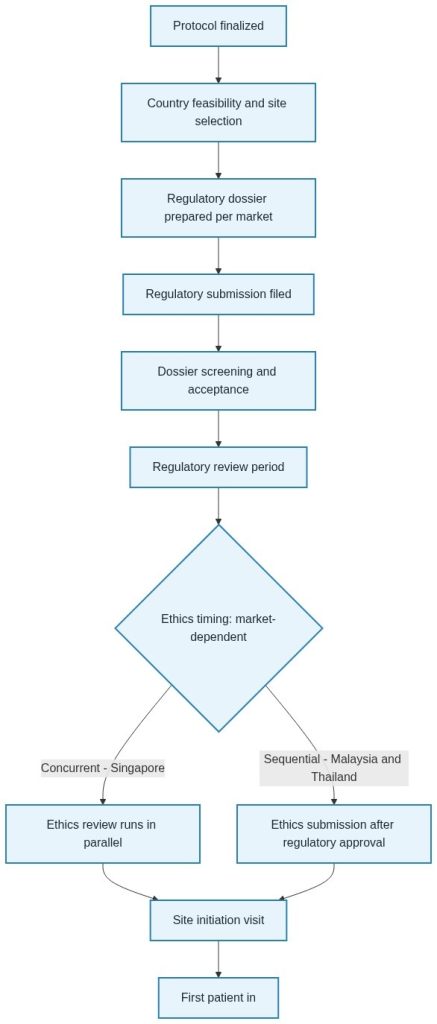
Steps from protocol finalization to first patient in for a multi-country APAC study. The sequential ethics path (shown right) applies in Malaysia and Thailand, where ethics submission follows regulatory approval. Singapore’s concurrent ethics review is shown on the left path. Actual step duration varies by market and site.
Conclusion
APAC regulatory timelines carry more operational complexity than any single statutory figure captures. Singapore does not gateway the region. Japan’s regulator moves faster than many sponsors assume. India’s 90-day rule starts later than expected and ends before all site approvals are in place. Ethics approval in Malaysia and Thailand sits on the critical path, not beside it. Sponsors who plan around these realities build more accurate timelines and face fewer mid-programme surprises.
Are You Planning a Multi-Country Study Across APAC?
Credevo supports sponsors across 13 APAC and US markets with regulatory strategy, site feasibility, and full-service clinical operations. If you’re scoping an APAC programme and want a realistic timeline model built from submission data rather than statutory ceilings, reach out to the team: credevo.com/contact.
Frequently asked questions
Why do APAC regulatory timelines vary so much between markets?
Each APAC market has a sovereign regulatory authority with its own legislation, submission format, and review process. Singapore’s HSA, India’s CDSCO, Japan’s PMDA, Malaysia’s NPRA, and Thailand’s Thai FDA each operate independently. No mutual recognition agreement for pharmaceutical clinical trial applications currently covers the major APAC pairs.
Beyond the regulatory structure itself, each market’s ethics committee system, site landscape, import permit requirements, and dossier format requirements add further variation. Statutory timelines give the regulatory floor only. Actual timelines reflect the interaction between the regulatory review, the ethics process, site readiness, and submission quality. Understanding these interactions at the country and site level is the foundation for accurate APAC planning.
How long does it actually take to get clinical trial approval in Japan?
Japan’s PMDA CTN review standard is 30 working days, which is approximately six calendar weeks. Before the 30-day period begins, PMDA screens the dossier for completeness. Deficiency queries during the review period pause the clock and add three to six weeks per round. IRB approval at each participating site runs after CTN filing and typically takes four to eight weeks depending on the institutional review board’s meeting schedule. Total time from regulatory submission to first patient in Japan is typically 20 to 26 weeks, depending on site IRB scheduling and protocol complexity. Sponsors who exclude Japan based on perceived regulatory slowness may be reacting to historical experience rather than current statutory timelines.
What does India’s 90-day NDCT rule actually cover?
The 90-working-day ceiling under the NDCT Rules 2019 covers CDSCO’s central review of a clinical trial application. The clock starts after CDSCO formally accepts the dossier, which requires successful submission via the SUGAM portal and a completeness check. Deficiency queries pause the clock; it resumes after the sponsor responds. After CDSCO grants approval, each participating site must obtain its own institutional ethics committee (IEC) approval before enrolling patients. IEC processes are independent at each site and are not governed by the 90-day rule. Multi-site India studies should plan for IEC timelines separately for each site, using data on meeting frequency and average review cycles rather than national averages.
Can sponsors run ethics and regulatory approval in parallel across all APAC markets?
No, and this is one of the most common planning errors in APAC trials. The relationship between regulatory and ethics timelines is market-specific and cannot be standardised across the region. Singapore’s HSA runs concurrent regulatory and ethics review as a single integrated process.
In Malaysia, ethics submissions at most institutional review boards cannot proceed until NPRA issues the CTIL or CTX approval. In Thailand, the ethics committee requires regulatory compliance confirmation from the Thai FDA before finalising its approval. In Japan, IRB review runs after PMDA CTN filing, not simultaneously. Each market’s regulatory-to-ethics sequencing should be confirmed during feasibility using site-specific data, not assumed to mirror Singapore’s concurrent model.
What is the fastest APAC market for clinical trial regulatory approval?
Singapore’s HSA consistently delivers the fastest combined regulatory and ethics timeline, typically completing in 8 to 12 weeks for moderate-complexity studies. This reflects HSA’s concurrent review model, which processes regulatory and ethics applications simultaneously. Japan’s PMDA CTN window of 30 working days is technically shorter for the regulatory component alone, but IRB approval in Japan runs separately and extends total time to 20 to 26 weeks. Malaysia’s NPRA recognition pathway targets 60 working days for regulatory review, followed by a separate ethics process. For sponsors building APAC portfolios, Singapore offers the fastest combined timeline, though portfolio decisions should weigh patient access, site quality, and strategic regulatory value alongside speed.