
ICH M14 and Non-Interventional Studies Using Real-World Data: What Asia-Pacific Sponsors Need to Prepare
If you run post-marketing safety studies on real-world data, you have worked without a single harmonised planning standard. Each region asked for something slightly different. For example, a protocol written for one regulator often needed rebuilding for the next. As a result, a sponsor with commitments in three markets could end up running three studies on one safety question.
That changed on 18 March 2026. ICH M14 carries reference number EMA/CHMP/ICH/155061/2024, and it took legal effect in the European Union on that date. ICH adopted the guideline at Step 4 in September 2025, and the European Medicines Agency published the Step 5 text in October 2025. Similarly, the US FDA issued its own final guidance in March 2026. Because the EMA describes this as the first harmonised guidance for non-interventional studies, it arguably resets the baseline rather than adding a layer.

This piece covers what ICH M14 asks for. It also covers how the guideline sits alongside national requirements in Asia-Pacific markets. Then it turns to what a sponsor with an active real-world evidence programme should review now. Finally, it flags what ICH M14 does not do, which matters as much as what it does.
If you have not yet updated your India regulatory planning to reflect the NDCT amendment rules 2026, your timelines rest on the old framework. This article explains what changed, what did not change, and what you need to do differently from mid-March 2026 onward.
Key takeaways
- ICH M14 took legal effect in the European Union on 18 March 2026, and the US FDA published its final guidance in March 2026.
- The guideline covers non-interventional studies using real-world data for post-marketing safety assessment, and its principles also apply to effectiveness studies.
- Its central demand is an iterative planning sequence: research question, then data fitness-for-use, then feasibility, then protocol and analysis plan.
- When FDA adopted ICH M14, it withdrew its May 2013 best practices guidance on pharmacoepidemiologic safety studies using electronic healthcare data sets.
- National requirements in Asia-Pacific markets still apply alongside ICH M14, because adoption runs through each regulator’s own process.
- The practical work for sponsors is documenting decisions that teams previously made informally, particularly around data source selection.
What ICH M14 actually covers
ICH M14 sets out general principles for planning, designing, analysing, and reporting non-interventional studies that use real-world data. The purpose is safety assessment of medicines, and the scope covers drugs, vaccines, and other biological products. According to the European Medicines Agency guideline page for ICH M14, the recommendations aim to reduce duplicate studies on the same safety concern. Similarly, they aim to improve regulatory acceptance of a protocol across regions.
Sponsors should read that second objective twice. Where a safety commitment spans several regulators, ICH M14 gives you a defensible basis for proposing one study rather than three. However, the guideline sets principles, not a template. Instead, it leaves the design, the data source, and the analytical method to the sponsor.
Studies inside and outside the scope
The guideline addresses non-interventional studies. In those studies, treatment decisions follow routine clinical practice rather than a protocol. Registry studies, database studies using electronic health records or claims data, and post-authorisation safety studies all sit inside that scope. Interventional trials sit outside it, and ICH E6(R3) Good Clinical Practice remains the standard governing their conduct.
While ICH M14 focuses on safety, the FDA notes that its recommendations also apply to non-interventional effectiveness studies. For sponsors building a programme with both objectives, that removes an awkward question. You no longer have to decide which standard governs which arm.
The iterative planning sequence ICH M14 expects
The structural change in ICH M14 is a sequence. Many teams write a protocol first and then look for data to fit it. In contrast, the guideline asks you to assess data fitness-for-use first, run a feasibility analysis, and then refine the design on what the feasibility returns.
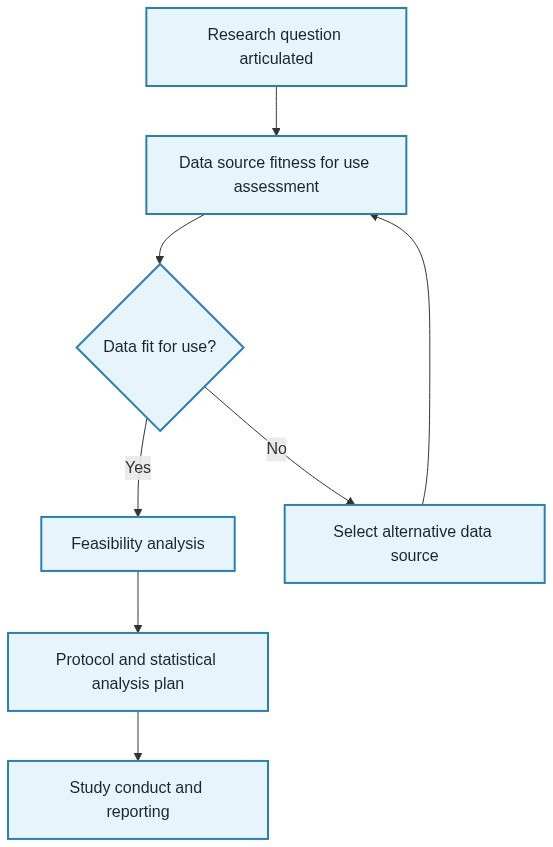
Figure 1: the iterative study development sequence in ICH M14. Where a data source fails the fitness-for-use assessment, the sponsor returns to data selection rather than moving on to the protocol.
Research question before data source
Articulating the research question comes first. It has to be specific enough to determine what data could answer it. A question phrased as “assess the hepatic safety profile” determines nothing. In contrast, one that names the exposure, the comparator, the outcome, the population, and the time window determines a great deal. Because the rest of the sequence flows from this step, a vague question makes every later decision arbitrary.
Data fitness-for-use, documented
Sponsors have always chosen data sources on some basis. ICH M14 asks you to write that basis down. Does the source capture the exposure reliably? Can investigators ascertain the outcome? Does follow-up run long enough, and does the population match the question? Since many teams treat this as internal judgement rather than a documented assessment, most of the new work sits here.
[VISUAL: comparison table, ICH M14 planning steps in one column against what a sponsor typically documents today in the other, with the gap flagged per step. File name: ich-m14_planning-step-gap-analysis_Credevo.png]
Feasibility before the protocol locks
Feasibility analysis then tests whether the chosen source can support the study at the planned precision. If sample size or outcome counts fall short, the design changes. Therefore the protocol arrives last in the sequence rather than first. It also arrives with a documented rationale for each design feature.
What ICH M14 means for the protocol and the analysis plan
The guideline expects a detailed protocol and a statistical analysis plan. Each needs a documented rationale for the design features chosen. Sponsors tend to underestimate that rationale requirement. A protocol that states a decision satisfies the old expectation. However, ICH M14 also wants the alternatives considered and the reason the chosen option fits the research question.
The analysis plan must name its biases and confounders
The FDA describes the guidance as covering several linked steps. Sponsors articulate the research question, select data sources, define key variables, address potential biases and confounding, conduct analyses, and report results. For observational work, confounding by indication and immortal time bias are the usual suspects. Therefore a plan that never names the specific threats to validity will read as incomplete.
Reporting follows the same structure
Because the guideline covers reporting as well as planning, the study report should trace back to the protocol and the analysis plan. The report documents deviations rather than quietly absorbing them. For sponsors used to looser reporting conventions in observational work, the discipline resembles what ICH E3 brought to clinical study reports.
How ICH M14 lands across Asia-Pacific markets
Sponsors need to be careful here. ICH guidelines take effect through each regulator’s own adoption process, and therefore timing and legal weight vary by market. Several Asia-Pacific authorities participate in ICH, while several markets where Credevo operates do not. ICH M14 consequently raises the planning standard across ICH and non-ICH markets alike, without displacing national requirements in either.
Markets that already expect structured post-marketing evidence
Japan, South Korea, Singapore, Australia, and Taiwan all run established post-marketing surveillance frameworks. Their authorities also participate in ICH. In each case, ICH M14 gives you a common planning framework, while the submission requirements remain local. Check the current position with each authority before you assume an effective date, because adoption timing differs.
Markets where ICH M14 is a reference point, not a rule
In markets such as India, Thailand, Vietnam, the Philippines, and Sri Lanka, national frameworks govern post-marketing studies. Sponsors still benefit from following ICH M14, because a protocol built to its sequence answers much of what most regulators ask. Where a local authority wants something the guideline does not cover, the local requirement wins. The protocol then carries both.
Practical consequence for multi-market programmes
Suppose your safety commitment spans an ICH market and a non-ICH market. Write the protocol to ICH M14 and add a local annex, rather than writing two protocols. As a result, this keeps one study, one analysis plan, and one dataset. That is exactly the outcome ICH M14 aims at. Our overview of real-world data and real-world evidence in clinical trials sets out the underlying study types. Separately, our piece on trial designs using real-world data covers the design options.
What the FDA withdrawal signals
The FDA did more than publish a new guidance. When it announced the final ICH M14 text, it also withdrew an earlier guidance. The withdrawn document is “Best Practices for Conducting and Reporting Pharmacoepidemiologic Safety Studies Using Electronic Healthcare Data Sets”, published in May 2013.
The FDA guidance page for ICH M14 carries docket number FDA-2024-D-2754 and confirms that withdrawal. If your pharmacovigilance or medical affairs SOPs cite the 2013 document, they now point at a withdrawn guidance. Because SOP reviews usually run annually, pulling this one forward is worth the effort.
What sponsors should review now
Three reviews cover the bulk of the near-term exposure for a sponsor with an active real-world evidence programme.
Studies already in protocol development
For any non-interventional safety study not yet locked, check two things. Does the protocol document the data fitness-for-use assessment? Does it document the feasibility result? If those steps happened but nobody wrote them down, reconstruct the documentation while the reasoning is fresh. That is cheaper than answering a regulator’s question about it eighteen months later.
Standard operating procedures and templates
Protocol templates, analysis plan templates, and study report templates for observational work all need a pass against ICH M14. In particular, add a rationale field wherever the template currently records only a decision. Sponsors who adapted interventional templates for observational use will find the gap wide, because those templates record only the decision.
Studies already running
For studies in conduct, the question is narrower. Will the study report satisfy a reviewer who reads it against ICH M14? Because the guideline covers reporting, a study planned under the old expectations can still produce a compliant report. The underlying decisions have to be sound, and the team has to be able to reconstruct the reasoning. Where it cannot, say so in the report rather than leaving the reviewer to find the gap.
Conclusion
ICH M14 does not make real-world evidence studies harder to run. It makes the reasoning behind them visible. That is a reasonable trade for a protocol several regulators can accept at once. For sponsors in Asia-Pacific, the work is documentation discipline where rigour was already expected, and a defensible planning framework where nothing was ever specified.
Are You Planning a Real-World Evidence Study Across Asia-Pacific Markets?
If you are scoping a post-marketing safety or effectiveness study, you may need a protocol that holds up across ICH and non-ICH markets. Credevo runs real-world evidence study design and reporting across its 13 markets, as part of both medical writing and full-service delivery. Please fill out the form below to connect with our team.
Frequently asked questions
When did ICH M14 come into effect?
ICH M14 reached Step 4 of the ICH process in September 2025 and entered Step 5, the implementation phase, at that point. The European Medicines Agency published the Step 5 guideline in October 2025 under reference EMA/CHMP/ICH/155061/2024. Its legal effective date in the European Union is 18 March 2026. The US FDA announced its final guidance in March 2026 under docket FDA-2024-D-2754. Implementation elsewhere follows each regulator’s own adoption process. Therefore a sponsor with commitments across several regions should confirm the local effective date rather than assuming a single global switch-on. Studies already in conduct are not automatically out of scope for reporting expectations, and consequently those need checking too.
Does ICH M14 apply to effectiveness studies or only safety studies?
ICH wrote the guideline for non-interventional studies assessing the safety of medicines, including drugs, vaccines, and other biological products. However, both the EMA and the FDA note that the key principles also apply to effectiveness studies. In practice, a sponsor running a real-world evidence programme with mixed objectives can plan the whole programme to one standard. The planning sequence, the data fitness-for-use assessment, and the documentation of design rationale all transfer directly. Where an effectiveness study carries a regulatory decision, check the relevant agency’s own real-world evidence guidance as well. Those documents set additional expectations that ICH M14 does not address.
Do Asia-Pacific regulators require compliance with ICH M14?
It depends on the market. Regulators adopt ICH guidelines through their own national processes, and consequently the effective date and the legal weight vary. In markets outside ICH membership, national requirements for post-marketing studies still govern. That said, a protocol built to the ICH M14 sequence will answer much of what most regulators ask. The sequence describes sound study planning rather than a jurisdictional rule. For a multi-market programme, the practical approach is one ICH M14-aligned protocol with a local annex per market. Confirm each authority’s current position before you file, because adoption status changes.
What is the biggest practical change ICH M14 introduces for sponsors?
Documentation of decisions that teams previously made informally. Most experienced pharmacoepidemiology groups already assess whether a data source fits the research question. They also consider feasibility before committing to a design. What changes is that ICH M14 expects that reasoning to appear in the protocol. The alternatives considered and the stated rationale for the chosen option both belong there. Therefore the work falls on templates and standard operating procedures rather than on scientific method. Teams that adapted interventional protocol templates for observational studies will find the largest gaps. Those templates record decisions without capturing the reasoning behind them.
Does ICH M14 replace any existing guidance?
In the United States, yes. When the FDA published its final ICH M14 guidance, it withdrew an earlier document. That document is “Best Practices for Conducting and Reporting Pharmacoepidemiologic Safety Studies Using Electronic Healthcare Data Sets”, published in May 2013. Sponsors whose pharmacovigilance or medical affairs SOPs cite the 2013 document should update those references. In the European Union, ICH M14 sits alongside existing pharmacovigilance requirements rather than replacing them. Post-authorisation safety study obligations therefore continue to apply. Elsewhere, national guidance on observational studies remains in force unless the local regulator says otherwise. Checking which documents your own SOPs cite is a short exercise, and it avoids an avoidable finding at inspection.